Why 90% of Hit Songs Use the Same 4 Chords, and How to Use This in Suno
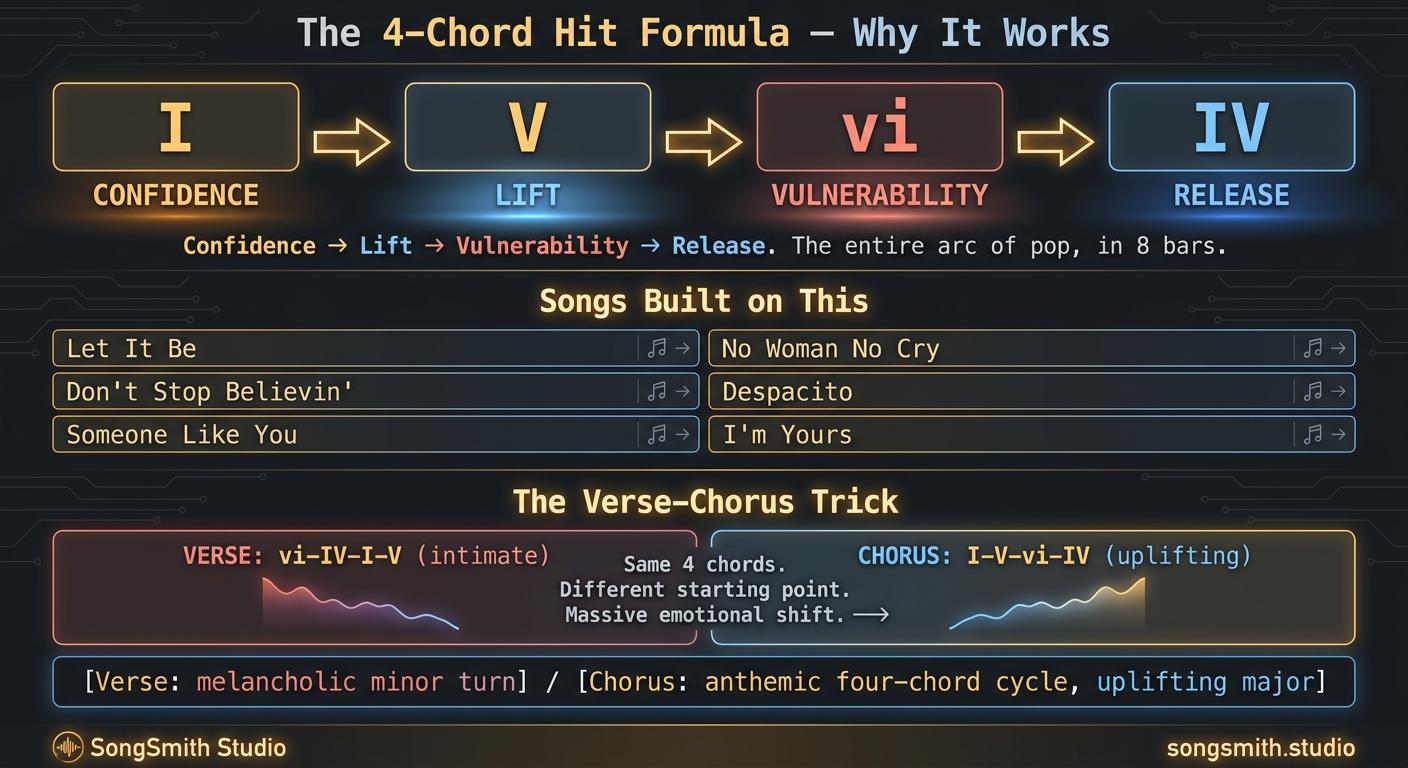
The "4-chord song" isn't a meme. It's a fact. The same four chords, in a few different arrangements, underpin Don't Stop Believin', Let It Be, Someone Like You, With or Without You, Despacito, Take Me Home Country Roads, Apologize, and roughly half of the Billboard top 100 of the last 30 years.
The progression: I - V - vi - IV (in C major: C - G - Am - F)
Why does it work? Because it pulls off three emotional moves in 8 bars:
- Confidence (I): the home chord, settled and stable
- Brightness (V): lift, anticipation
- Sadness (vi): minor turn, emotional vulnerability
- Release (IV): uplift, resolution promise
Confidence → lift → vulnerability → release. That's the entire emotional arc of a pop song, compressed into 4 chords. Then it loops, and the listener's brain rewards them for predicting it. Earworm engineered.
How to summon this in Suno (without naming chords)
Suno doesn't read chord notation, but it absolutely responds to progression description. Use these tags:
For the I-V-vi-IV feel:
"Hopeful pop progression, descending bass line, four-chord cycle, anthemic resolution, warm major key with minor turn"For the I-V-vi-IV in folk/country:
"Classic country progression, four-chord cycle, descending walking bass, warm acoustic harmonic motion"For the I-V-vi-IV in EDM:
"Anthemic EDM, four-chord progression, melodic main loop, bright major harmony with minor lift, festival-ready"The variation that makes it not boring
Pure I-V-vi-IV gets predictable. The trick: use it for the chorus only. Verses get a different progression, often the same chords in a different order. This is the formula:
- Verse: vi-IV-I-V (starts on minor, feels intimate, sad)
- Chorus: I-V-vi-IV (starts on major, feels uplifting)
Same 4 chords. Different starting point. Massive emotional difference.
In Suno terms:
[Verse: melancholic minor turn, intimate harmony]
[Chorus: uplifting major resolution, anthemic four-chord cycle]
Songs that prove it
Same exact 4 chords:
- Let It Be (Beatles), I-V-vi-IV
- No Woman No Cry (Marley), I-V-vi-IV
- Don't Stop Believin' (Journey), I-V-vi-IV
- Someone Like You (Adele), A-E-F#m-D = I-V-vi-IV in A
- Despacito: same
- I'm Yours (Jason Mraz), same
You've heard this progression 100,000 times. That's the point.
The advanced move: the "broken cycle"
After 3 loops of I-V-vi-IV in your chorus, delay the resolution on loop 4. Tag it:
[Final Chorus: extend the V chord, hold the tension before resolving to home]This is what makes the final chorus feel like a payoff. Suno respects this when prompted clearly.
Pro tips
- Don't only use I-V-vi-IV. Use it as the chorus chassis, then experiment in verses.
- Pair it with unusual lyrics. Predictable harmony + surprising lyrics = hit. Predictable harmony + predictable lyrics = elevator music.
- For minor-key songs, the equivalent progression is i-VI-III-VII (also wildly common, used in Stairway to Heaven, Hello, Beat It).
- The I-V-vi-IV loop is most effective at 80-130 BPM. Outside that range, the brain's pattern-recognition kicks in differently.
- Adding a key change up a step on the final chorus + this progression = the most reliable "emotional climax" formula in pop music.
Bookmark this. What hit song surprised you when you realized it uses the 4-chord progression?
AI-generated lyrics with structure built in
SongSmith generates complete lyrics with [Verse], [Chorus], and [Bridge] tags already in place — ready for Suno Custom Mode.
Get started freeKeep reading
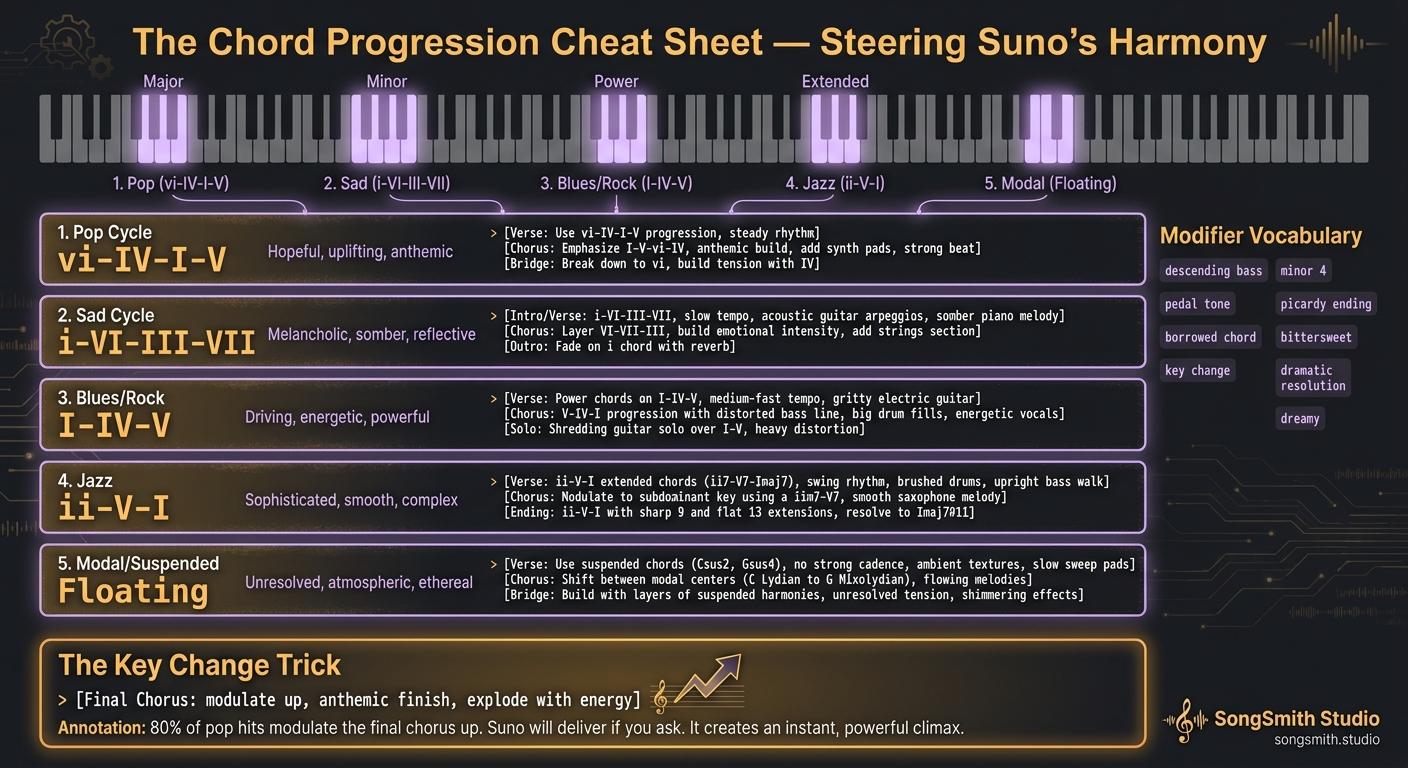
The Chord Progression Cheat Sheet: Tags That Actually Steer Suno's Harmony
Suno doesn't read chord names but responds to progression descriptions. 5 archetypes (pop cycle, sad cycle, blues, jazz, modal), modifier vocabulary, and the key-change trick.
2 min read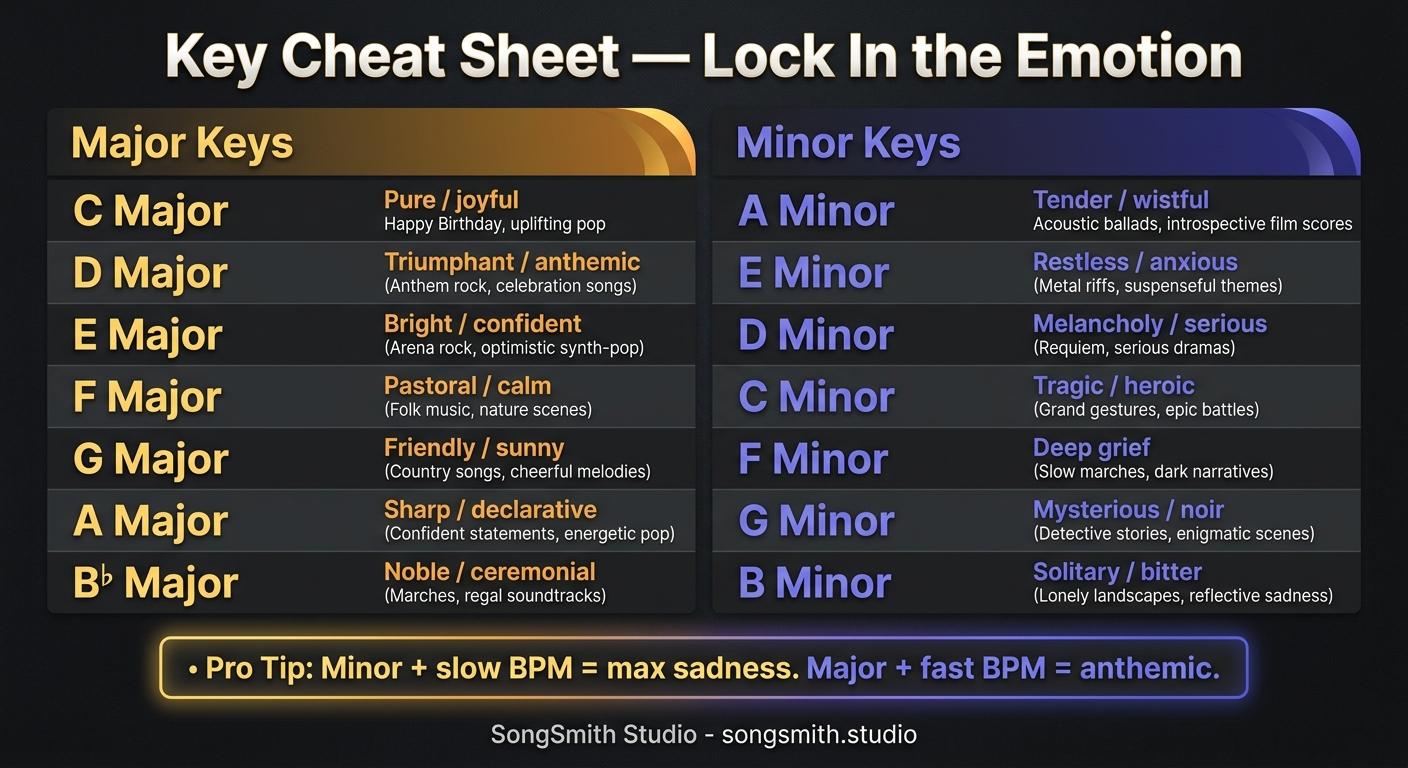
Key Cheat Sheet: Lock In the Emotion of Your Suno Song
Every major and minor key has its own emotional fingerprint. Use this reference chart to specify the exact key Suno should use, and stop defaulting to bland C major.
3 min read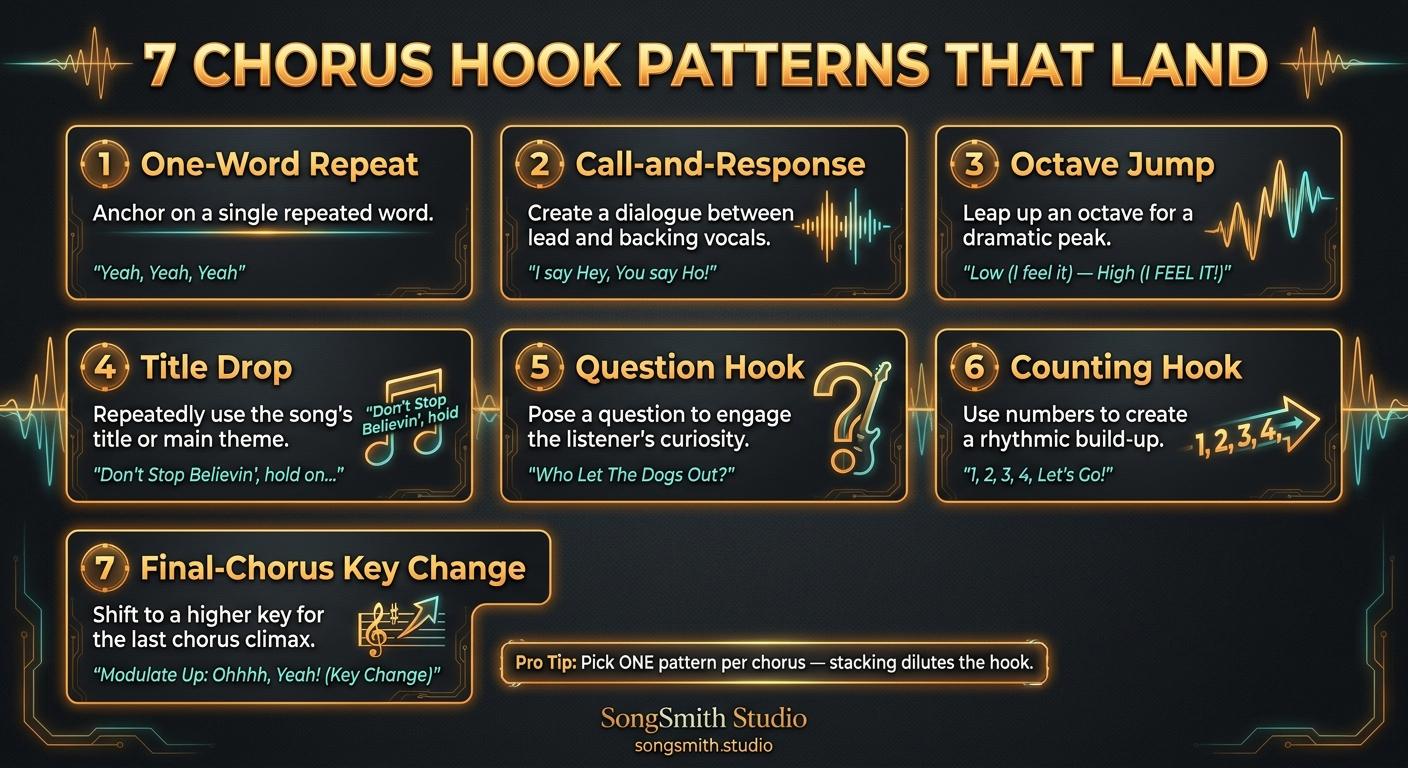
The Chorus Hook Cheat Sheet: 7 Patterns That Actually Land on Suno
Stop writing choruses that are just louder verses. 7 chorus hook patterns (one-word repeat, call-and-response, octave jump, title drop, and more) with copy-paste examples for Suno.
4 min read