The Chorus Hook Cheat Sheet: 7 Patterns That Actually Land on Suno
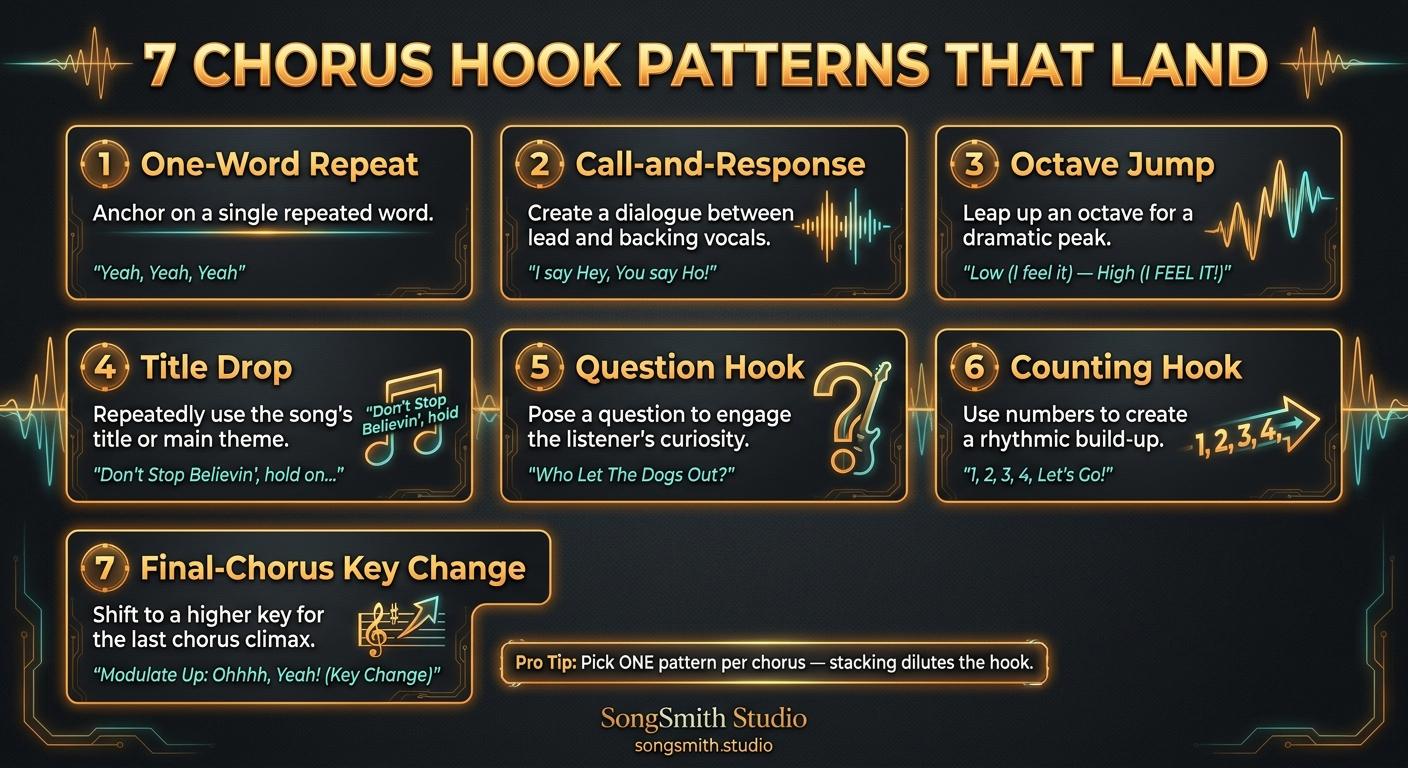
A chorus is not "the loud part." A chorus is the part listeners can repeat after one play. That requires a pattern. Something the ear locks onto. Most "okay" Suno songs have a chorus that's just a louder verse with the same melodic shape. Real choruses use a recognizable pattern that elevates them above the rest of the song. Here are 7 patterns that work consistently on Suno, with a 4-line example for each.
Pattern 1: The One-Word Repeat
Anchor the chorus on a single repeated word. Adele's "Hello" is the canonical template. The repetition does the memorability work for you. Listeners only need to remember one word.
[Chorus]
Hello, hello: I keep saying hello
Hello to a room that won't say it back
Hello, hello: I'm louder this time
Hello to whoever's still listening
Pattern 2: Call-and-Response
Lead vocal sings a line, backing vocals echo a fragment. The interaction creates motion and depth without changing the chord progression. Pair this with the vocal stack cheat sheet for backing-vocal tags.
[Chorus]
I was running (running)
I was hiding (hiding)
I was burning every photograph (every one)
And calling it free (calling it free)
Pattern 3: The Octave Jump
Verse sits in low register; chorus jumps an octave on the first word. The pure pitch contrast does the lifting. This works best when you tag the sections explicitly so Suno knows to drop the verse register.
- Tag the verse:
[Verse: low register, intimate] - Tag the chorus:
[Chorus: octave up, belted, soaring]
Pattern 4: The Title Drop
The chorus contains the song title as the first or last line. Sticky on first listen because the listener immediately associates the most memorable melodic moment with the song's name.
[Chorus]
Every long road / leads to you
The map was wrong / but the wheels were true
This is the part where I stop pretending
Every long road
Pattern 5: The Question Hook
Chorus is built around a single repeated question. The unresolved question keeps the listener mentally engaged through the rest of the song waiting for an answer.
[Chorus]
What if I stayed? What if I stayed?
What if the door I closed was the only door?
What if the song I never wrote
Was the only one that mattered anymore?
Pattern 6: The Counting Hook
Numbers create rhythm and memorability. 1-2-3, days of the week, ages. The numerical structure gives the listener a built-in mental scaffolding to remember the lyric.
[Chorus]
One: I'll forget your name
Two: I'll burn the frame
Three: I'll learn to sleep again
Four: I won't remember when
Pattern 7: The Final-Chorus Key Change
Standard pop move: modulate up a whole step on the last chorus. Hits like a hammer. Tag it explicitly so Suno honors the modulation rather than just changing the vocal energy.
[Final Chorus: key change up a whole step, full vocal stack, soaring]Pro Tips for Using Chorus Patterns
- Pick one pattern per chorus. Stacking patterns dilutes the hook.
- Patterns 1, 2, 4, and 6 are the stickiest on first listen. Best for songs you want to spread quickly.
- Patterns 3 and 7 reward replay value, best for albums and deeper listens.
- Always wrap chorus structural notes in square brackets. Suno will sing parentheses as lyrics.
- Combine the chosen pattern with a vocal stack in the chorus only. Keeps the verse intimate and the chorus huge.
How to Use a Chorus Pattern in a Full Song
Pick the One-Word Repeat for your next song. It's the lowest-friction pattern to test. Here's a full prompt + lyric block to paste into Suno:
Style Prompt
indie alt-pop, longing, chiming guitars and warm pad, breathy female vocal, spacious mix, 96 BPMLyrics
[Verse]
The light from the window won't quit
It finds me wherever I sit

[Chorus]
Stay, stay: just say you'll stay
Stay through the part I can't say
Stay, stay: I'll learn how to ask
Stay, just for the rest of today
Generate, then tweak. The pattern does most of the memorability work. Your job is just to write four lines that fit it.
Patterns Beat Volume Every Time
The lazy way to make a chorus stand out is to make it louder. The real way is to make it *patterned*. A patterned chorus is one a listener can hum after a single play, and that's the only metric that matters for whether your song sticks.
AI-generated lyrics with structure built in
SongSmith generates complete lyrics with [Verse], [Chorus], and [Bridge] tags already in place — ready for Suno Custom Mode.
Get started freeKeep reading
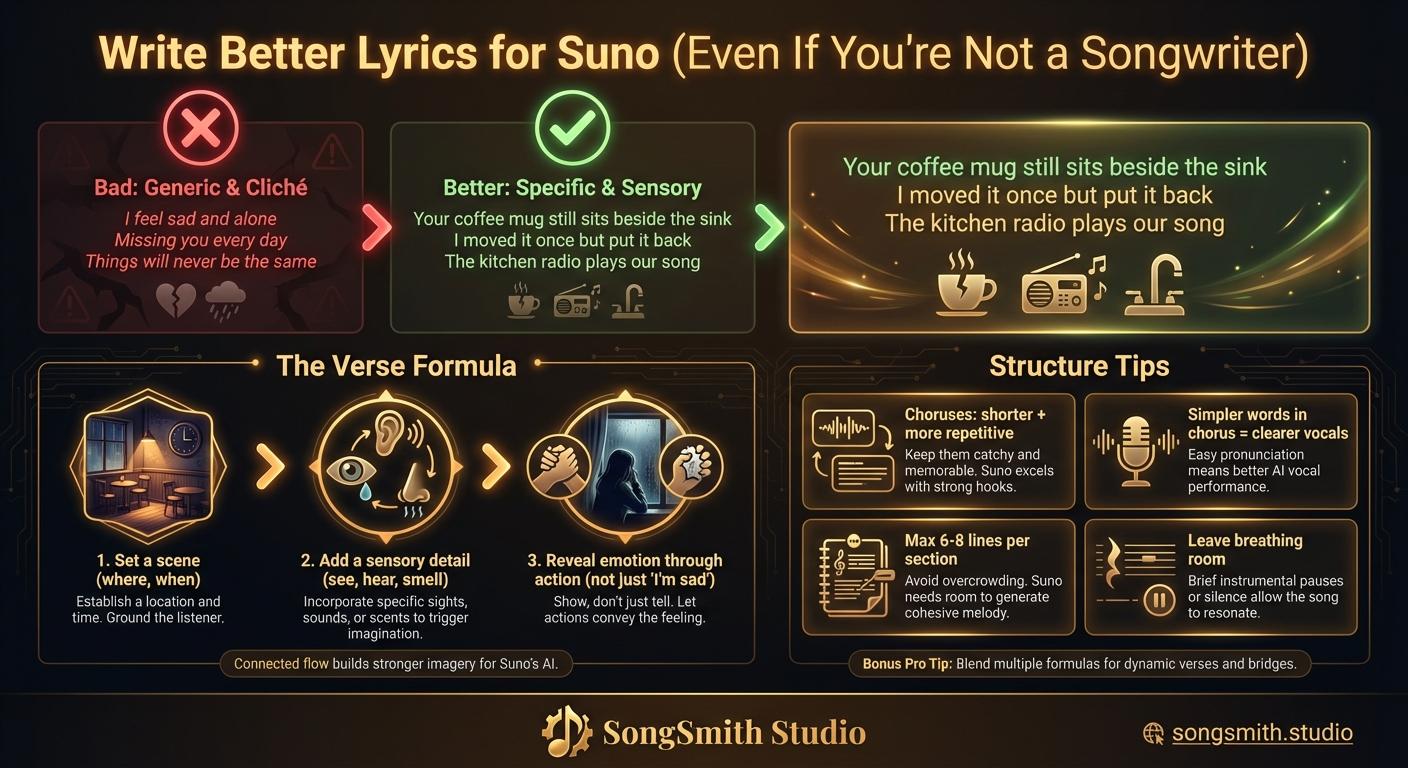
How to Write Lyrics for Suno That Actually Sound Like Real Songs
Learn how to write better lyrics for Suno by using specificity instead of vague emotions. A practical formula that works even if you're not a songwriter.
3 min read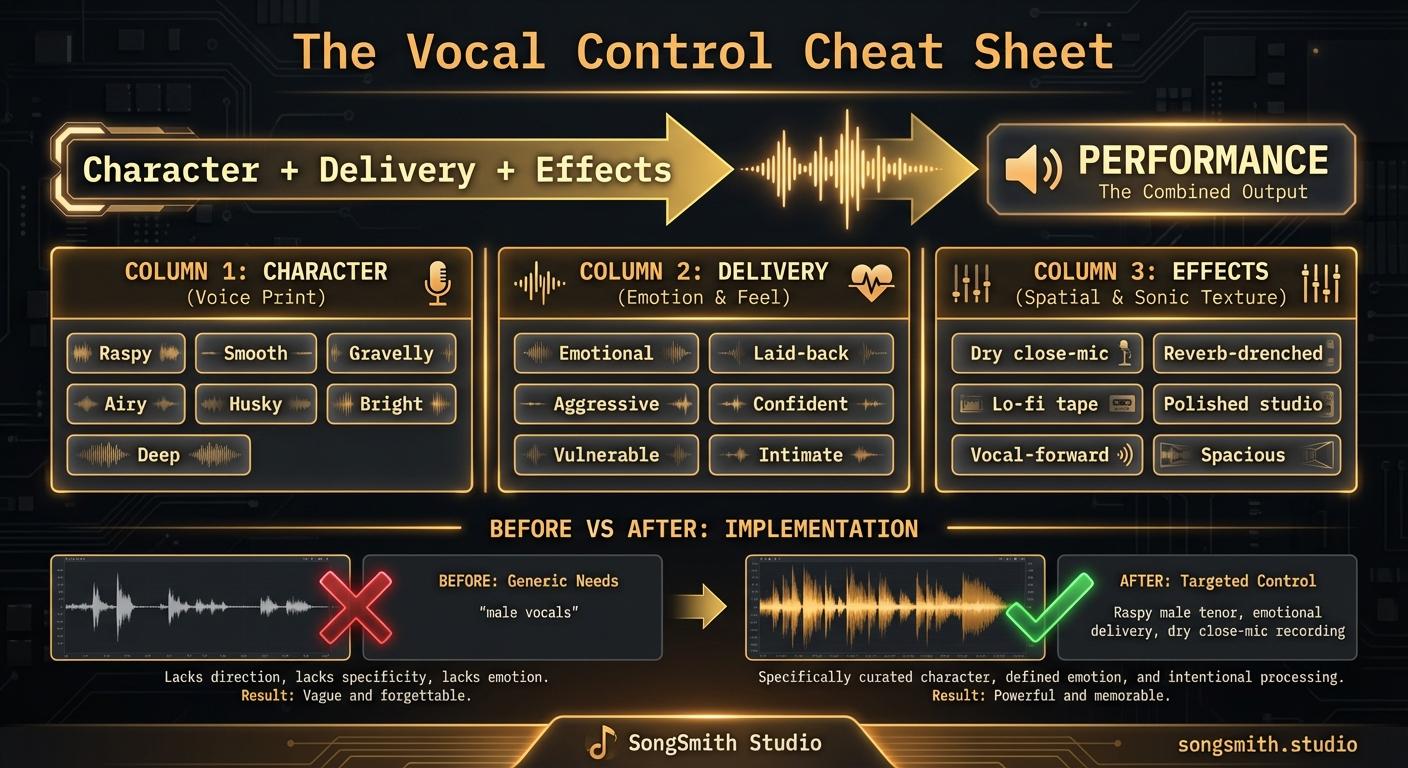
The Vocal Control Cheat Sheet: Master the 3-Layer Formula
Control Suno vocals with the Character + Delivery + Effects formula. Master male, female, and unique vocal descriptions for professional-sounding AI music.
3 min read![Dark-themed cheat sheet with two columns. Stacking & Layering on the left (6 tags) and Effects on the right (6 tags), totaling 12 numbered rows. Each row shows the tag name in bold and a one-line description. Stacking tags: double-tracked, octave stack, layered harmonies, gang vocals, call-and-response, ad-libs. Effect tags: autotuned, vocoder, talkbox, reverb-drenched, slapback delay, whisper layer. Each column has a colored left accent bar. Bottom banner: Dry verse + stacked chorus = dynamic contrast. Below that, a code example of a [Chorus] section with stack tags.](/_next/image?url=%2Fblog%2F34-suno-vocal-stack-cheat-sheet.png&w=3840&q=75)
The Vocal Stack Cheat Sheet: 12 Tags That Make Suno Vocals Sound Pro
Pro-sounding choruses are never one voice. Use these 12 vocal-stacking and effect tags: doubles, harmonies, ad-libs, vocoder, reverb, to lift any Suno generation.
3 min read