Genre Anti-Pairs: 6 Genre Combos That Sound Like Mush on Suno (And Why)
Most genre-blending posts tell you what combos to try. This is the opposite: the combos that almost never work, with the actual reason each one fails.
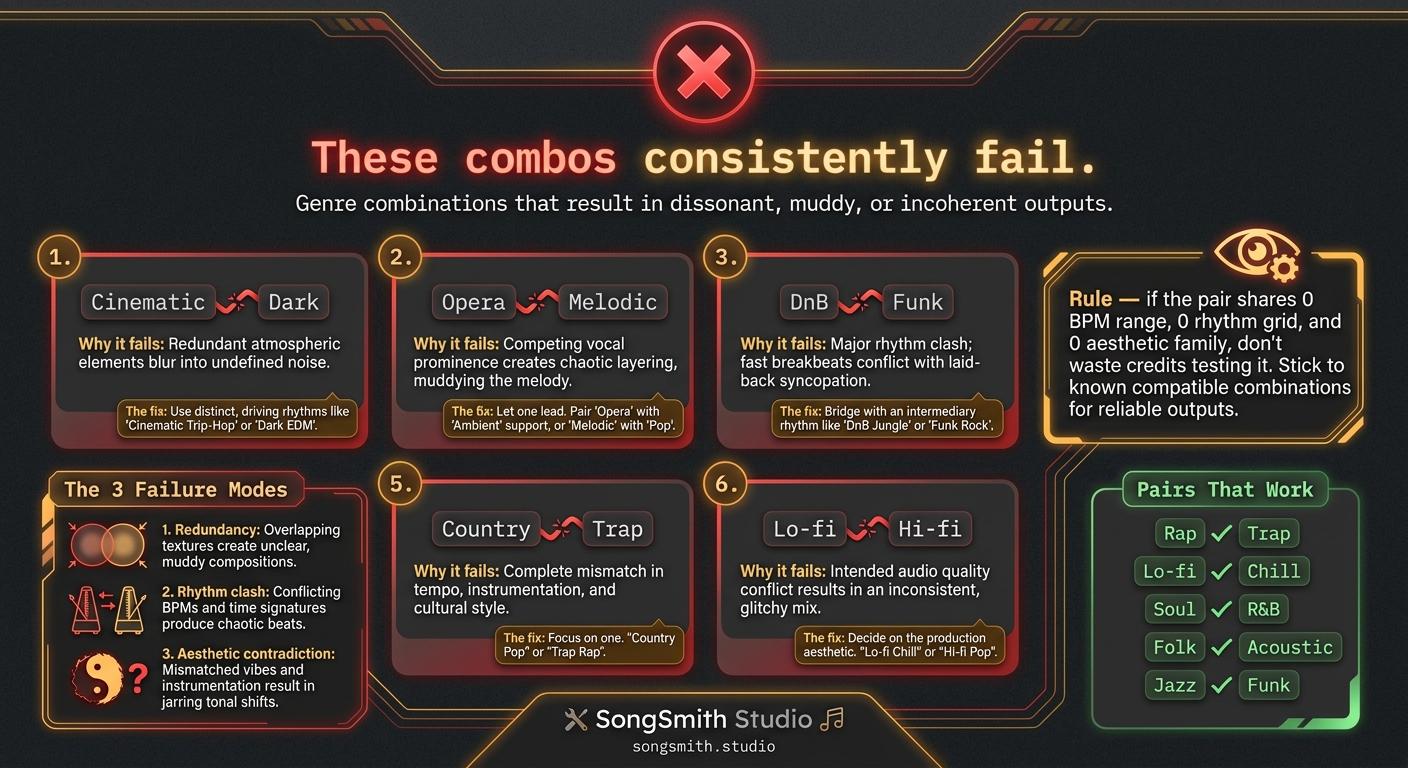
Anti-Pair 1: Cinematic + Dark
Why it fails: both are mood modifiers, not genres. "Cinematic" implies orchestral grandeur. "Dark" implies brooding minor-key heaviness. Stacking them tells Suno "be moody and big at the same time", which is already implied by either one alone. The model over-saturates the prompt and produces something that sounds like a movie trailer made by a committee.
The fix: pick one. "Cinematic" with a minor key handles the dark instruction. "Dark electronic" handles the cinematic intensity. Don't double-mood.
Anti-Pair 2: Opera + Melodic
Why it fails: opera is already melodic by definition. Adding "melodic" is signal noise. Suno has nothing extra to do with it. Worse, "melodic" pulls the model toward modern pop melodicism, which fights opera's classical phrasing. Result: half-baked opera with pop-song contours.
The fix: opera + specific descriptor (operatic + soprano + Italian + dramatic). The descriptors give Suno traction. "Melodic" doesn't.
Anti-Pair 3: Drum and Bass + Funk
Why it fails: rhythm clash. Drum and Bass lives at 160-180 BPM with broken beats. Funk lives at 95-110 BPM with the one-on-the-one. There's no BPM where both feel correct, and Suno averages them into a tempo that satisfies neither.
The fix: pick the BPM you want, then commit. DnB at 170 with funky bass = "neurofunk." Funk at 100 with breakbeat hi-hats = "future funk." Don't ask for both as headline genres.
Anti-Pair 4: Ambient + Trap
Why it fails: ambient is patience music. Long sustains, no driving rhythm, sparse vocals. Trap is event music, punchy 808s, hi-hat rolls, vocal-forward delivery. They share zero core characteristics. Asking for both creates a song that has neither ambient's contemplation nor trap's energy.
The fix: "atmospheric trap" works (atmospheric is a texture, not a genre). "Ambient + trap" doesn't.
Anti-Pair 5: Country + Trap
Why it fails: this can work if you commit to one of the existing subgenres (country trap, hick-hop), but writing "country + trap" as two separate primary genres confuses Suno about which rhythm grid to use. Country lives on quarter-note feel. Trap lives on triplet hi-hats. Suno can't run both rhythms at once.
The fix: use the existing subgenre tag. "Country trap" or "modern country with 808 elements" works much better than two competing genre tags.
Anti-Pair 6: Lo-fi + Hi-fi (or Lo-fi + Polished)
Why it fails: this should be obvious but I see it a lot. Lo-fi explicitly means degraded, warm, imperfect, tape-saturated. Hi-fi / Polished explicitly means clean, compressed, modern, radio-ready. You can't be both. Suno either picks one (usually whichever came first) or produces a song that sounds undermixed.
The fix: pick the aesthetic. If you want "modern lo-fi," say "lo-fi with crisp drums", that gives Suno specific guidance about which lo-fi tropes to keep and which to skip.
The pattern behind all anti-pairs:
Anti-pairs share one of three failure modes:
- Redundancy: both tags imply the same thing (Cinematic+Dark, Opera+Melodic)
- Rhythm clash: different BPM ranges or rhythmic grids that can't coexist (DnB+Funk, Country+Trap)
- Aesthetic contradiction: one tag negates the other (Lo-fi+Hi-fi, Ambient+Trap)
When you're combining genres, ask: do they share a BPM range? Do they share a rhythm grid? Do they share an aesthetic family? If yes to all three, the pair has a shot. If any answer is no, it's an anti-pair.
The high-value pairs that consistently work (for contrast):
Just so the post isn't all negative, here are the combos that do layer cleanly:
- Rap + Trap (same rhythm grid, overlapping BPM, same aesthetic family)
- Lo-fi + Chill (same aesthetic family, complementary mood)
- Metal + Rock (parent + child genre, metal is a rock subgenre)
- Orchestral + Epic (shared aesthetic, mutually reinforcing)
- Soul + R&B (overlapping vocal style and instrumentation)
- Synthwave + Synth (parent + descriptor)
- House + Deep (parent + subgenre modifier)
- Folk + Acoustic (style + instrumentation pair)
- Jazz + Funk (shared roots, compatible rhythm at 95-115 BPM)
Pro tips:
- If you must combine an anti-pair, drop one to a modifier instead of a primary genre. "Pop with cinematic strings" works. "Pop + cinematic" doesn't.
- The first genre tag carries the most weight. If you absolutely need a fusion, put the dominant genre first and the secondary as a modifier, "trap, with country guitar accents."
- Sub-genre tags often solve genre-fusion problems on their own. "Country trap" is a real genre with its own training data. "Country + trap" is two genres fighting.
- When in doubt, max 2 genres total, and pick from the same aesthetic family.
- The save-worthy rule: if the pair shares zero BPM range, rhythm grid, or aesthetic family, it will fail. Don't waste credits testing it.
Save this. What genre combo completely failed for you on Suno? Drop the prompt below and I'll tell you which of the three failure modes it hit.
Create your first Suno album on SongSmith
From a single idea to a complete, YouTube-ready album. AI lyrics, Suno automation, album art, and video rendering — all in one workflow.
Get started freeKeep reading
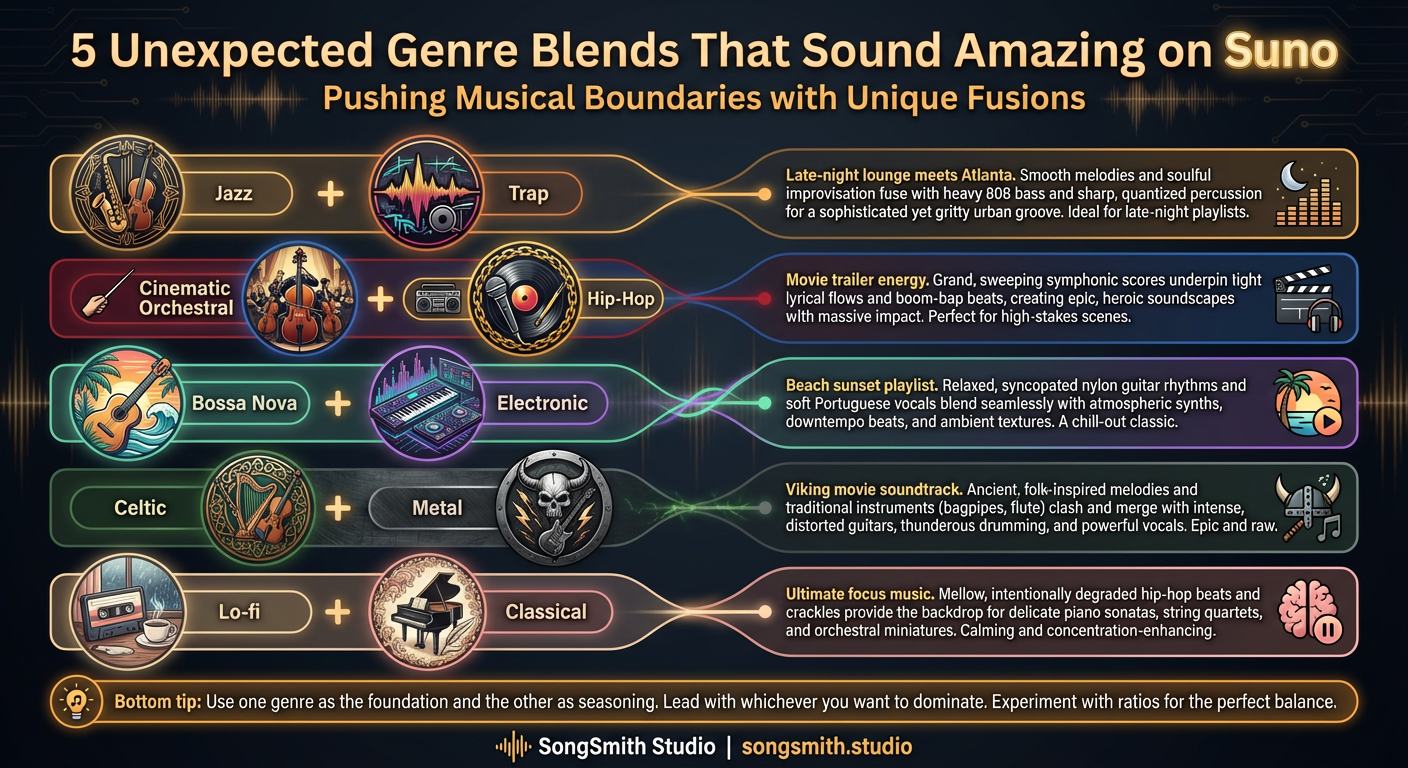
5 Unexpected Genre Combinations That Produce Great Suno Songs
Discover 5 surprising genre blends that work great on Suno. Jazz + Trap, Bossa Nova + Electronic, Lo-fi + Classical, and more unexpected combos that create incredible tracks.
2 min read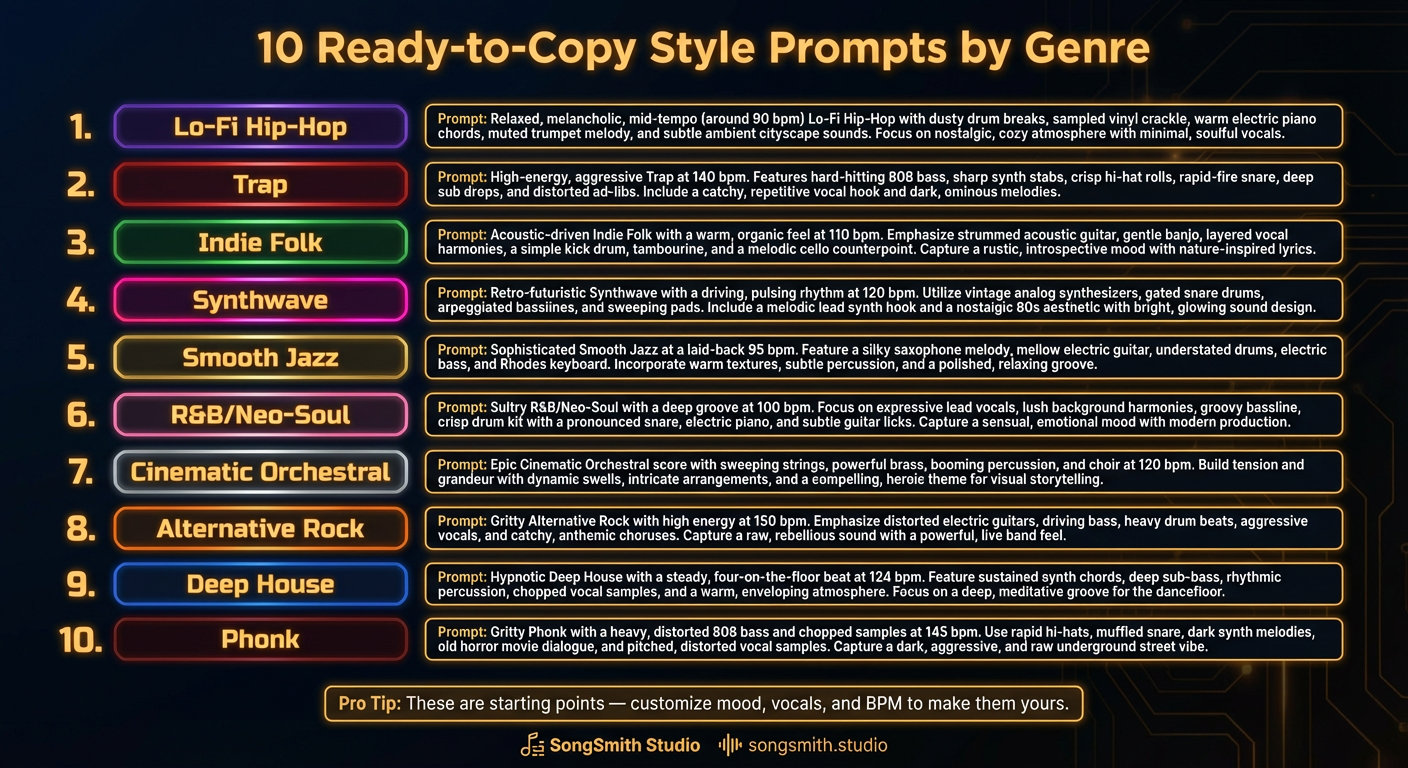
10 Ready-to-Copy Style Prompts by Genre
Copy 10 battle-tested Suno style prompt templates: lo-fi, trap, indie folk, synthwave, smooth jazz, neo-soul, orchestral, alt rock, deep house, phonk.
3 min read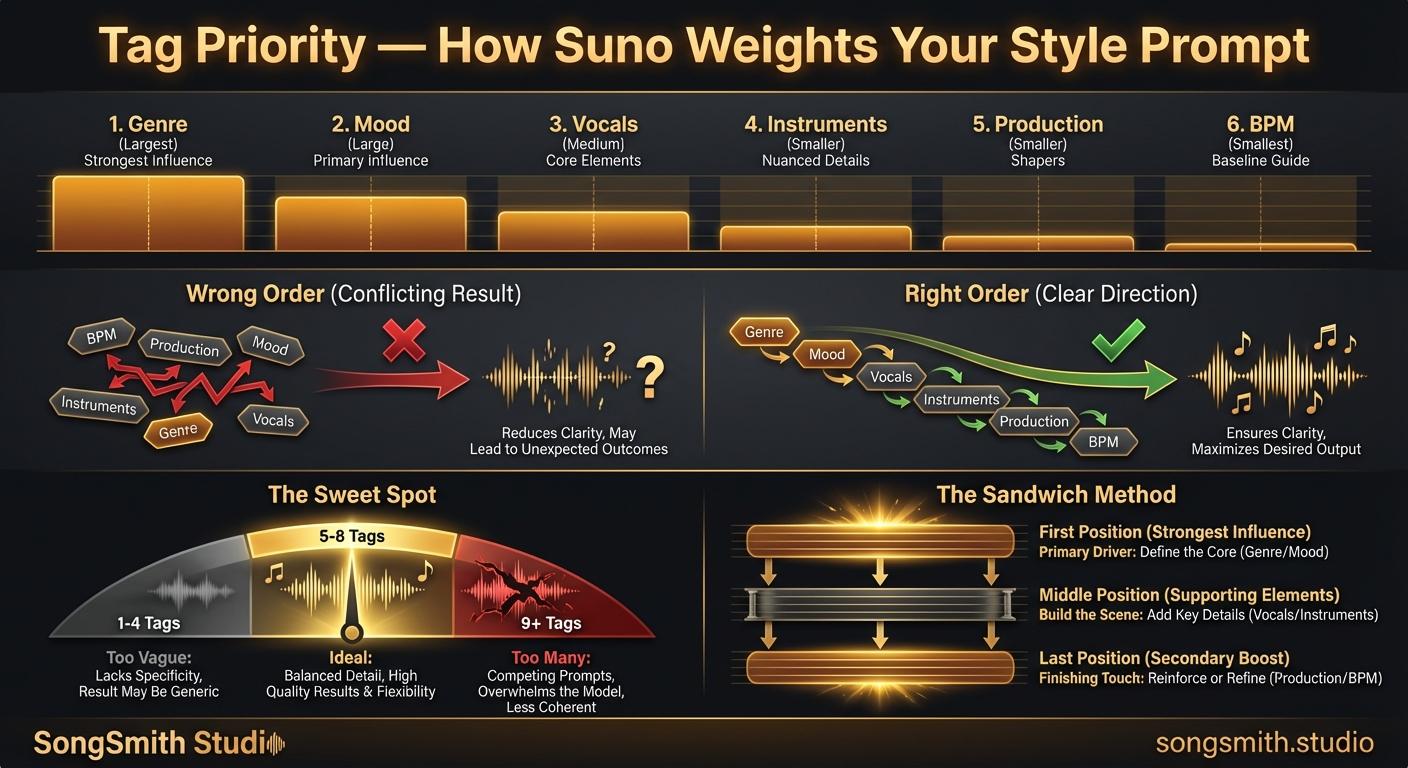
Tag Priority: How Suno Weights Your Style Prompt
Learn how Suno weights style prompt positions. First tag = 30% influence. Optimal order: genre, mood, vocals, instruments, production, BPM.
3 min read