Suno Tips & Guides

Expert tips, cheat sheets, and tutorials to help you create better AI music with Suno.
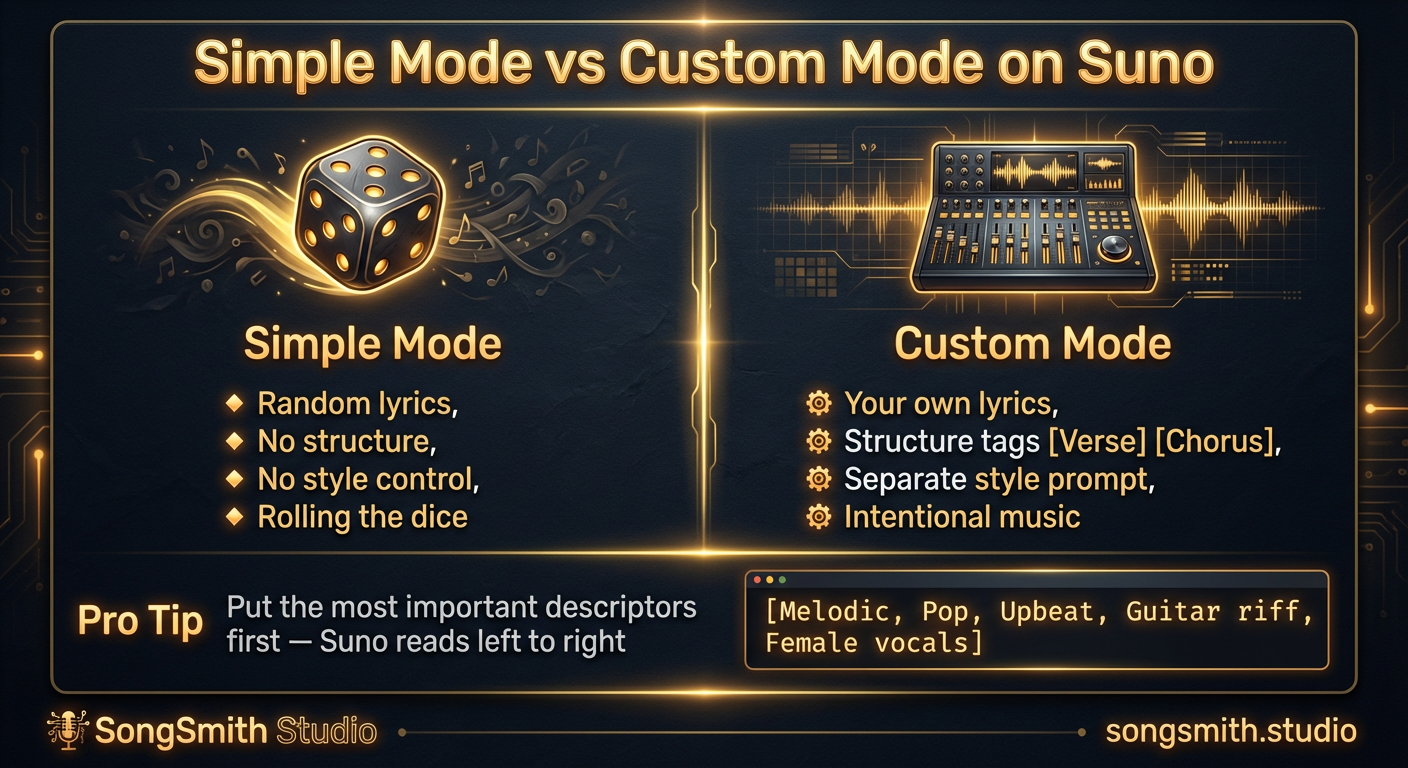
Side-by-side comparison showing Simple Mode (dice icon, random lyrics, no structure, no style control) versus Custom Mode (mixing console icon, your own lyrics, structure tags, separate style prompt, intentional music).
Prompting & Style

Why Custom Mode Gives You Total Control Over Your Suno Songs

Learn why Simple Mode limits your Suno songs. Switch to Custom Mode to write your own lyrics, control structure, and get intentional music instead of random results.

2 min read
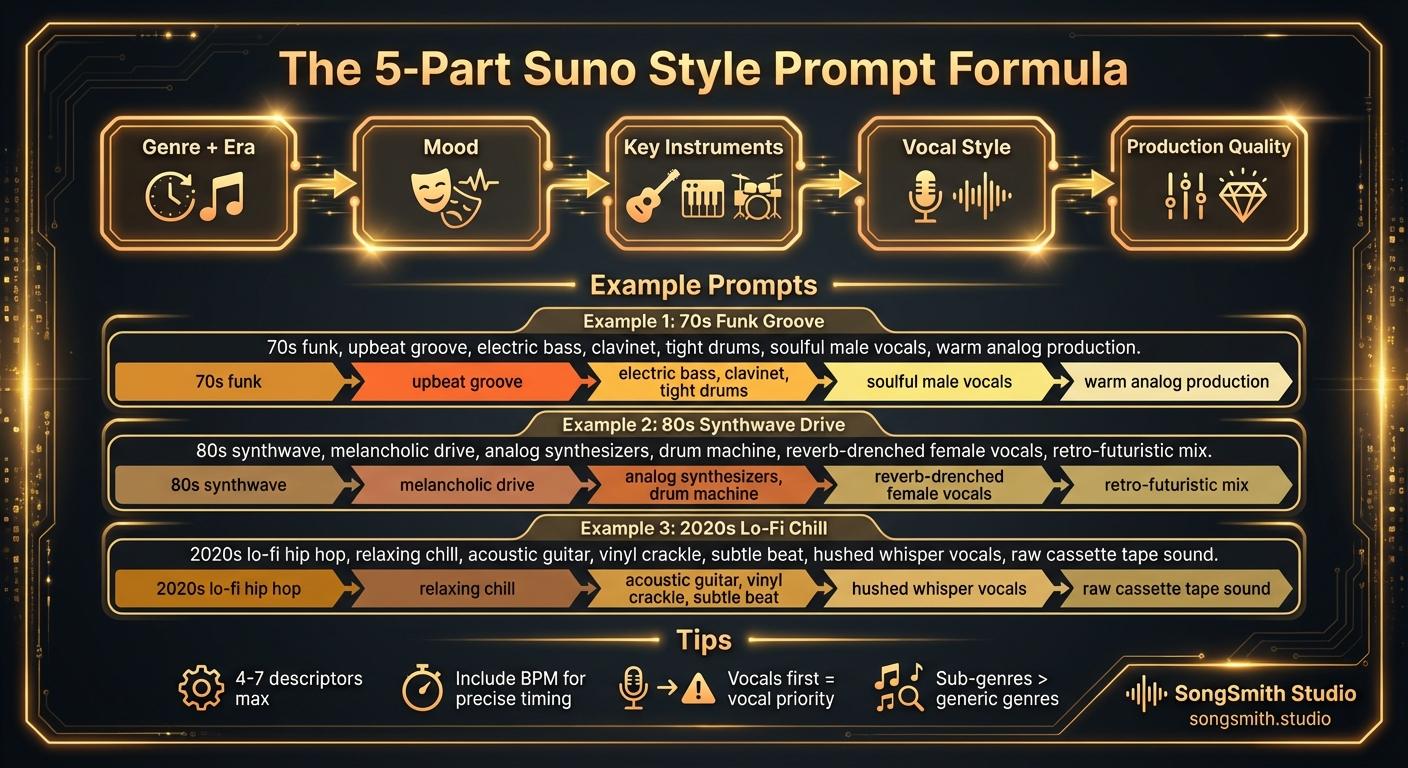
Horizontal pipeline flow diagram showing the 5-part Suno style prompt formula: Genre + Era → Mood → Key Instruments → Vocal Style → Production Quality. Below are 3 example prompts with color-coded sections matching each pipeline stage.
Prompting & Style

Craft Precise Style Prompts Using This Battle-Tested Formula

Master the 5-part formula for Suno style prompts: Genre + Era, Mood, Instruments, Vocal Style, Production. Learn tips for better results and example prompts that work.

2 min read
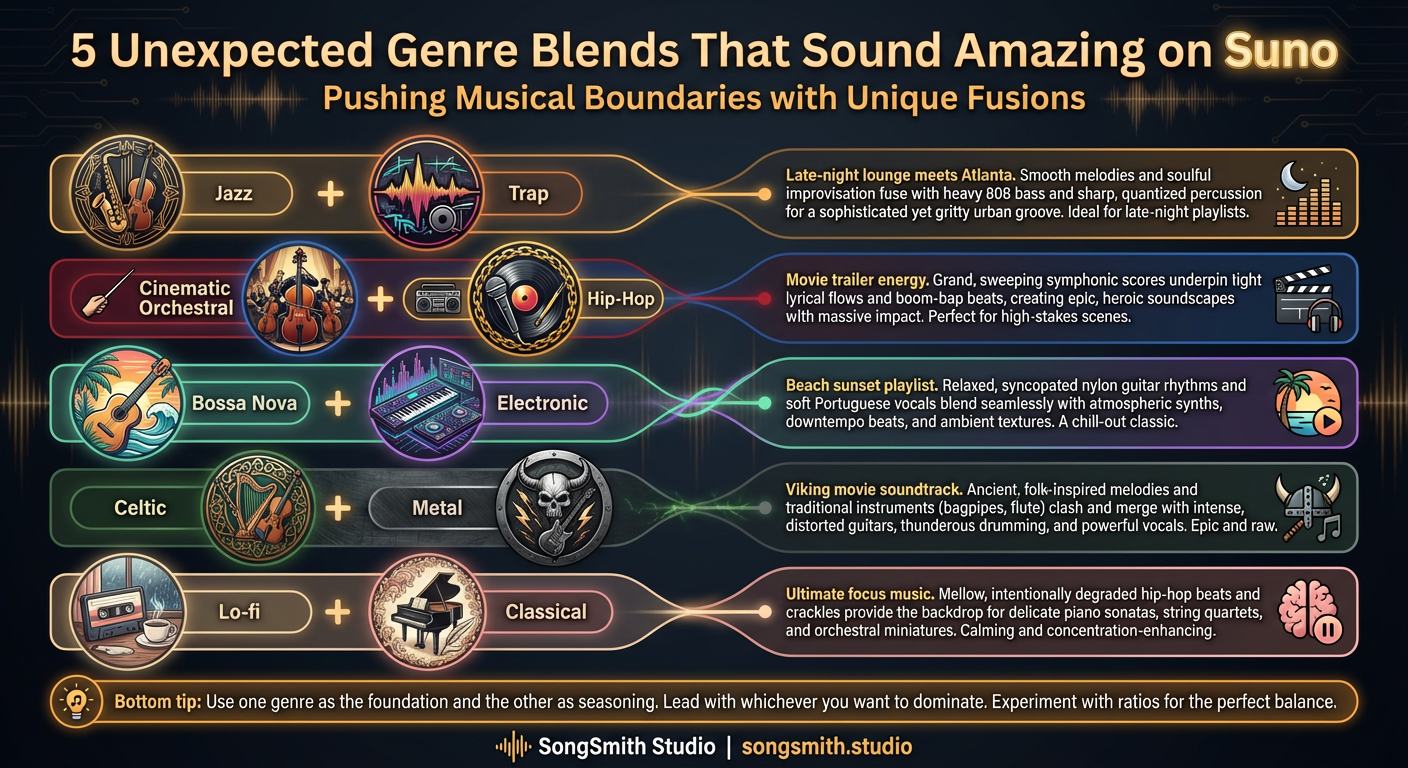
Dark-themed infographic showing 5 genre blend rows: Jazz + Trap equals late-night lounge, Cinematic Orchestral + Hip-Hop equals movie trailer energy, Bossa Nova + Electronic equals beach sunset, Celtic + Metal equals Viking soundtrack, Lo-fi + Classical equals focus music. Bottom tip: use one genre as foundation and the other as seasoning.
Prompting & Style

5 Unexpected Genre Combinations That Produce Great Suno Songs

Discover 5 surprising genre blends that work great on Suno. Jazz + Trap, Bossa Nova + Electronic, Lo-fi + Classical, and more unexpected combos that create incredible tracks.

2 min read
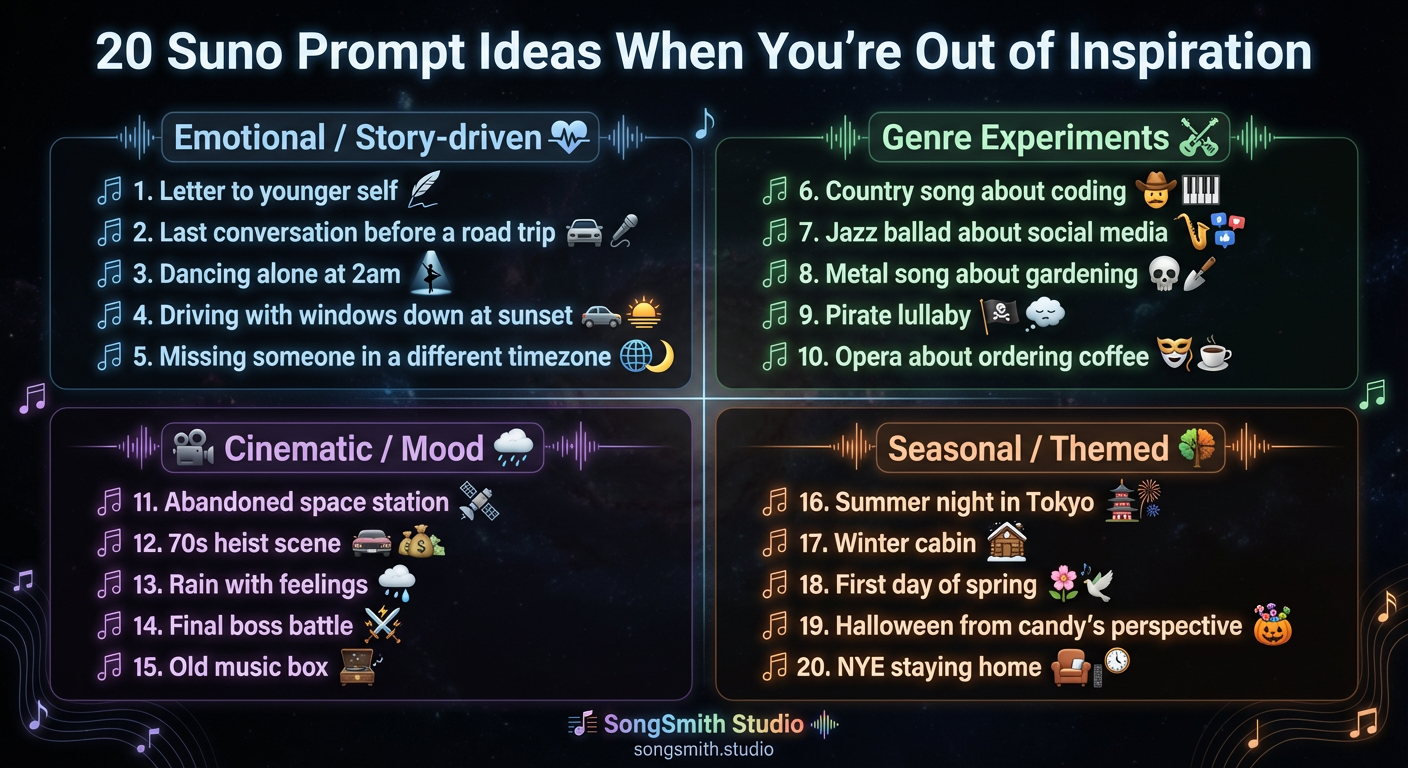
Four-quadrant infographic showing 20 Suno prompt ideas organized by category: Emotional/Story-driven (1-5), Genre Experiments (6-10), Cinematic/Mood (11-15), and Seasonal/Themed (16-20), with each quadrant in a different subtle accent color.
Prompting & Style

20 Suno Prompt Ideas When You're Completely Out of Inspiration

20 ready-to-use song concepts organized by category. Emotional stories, genre experiments, cinematic moods, and seasonal themes to spark your next Suno creation.

2 min read
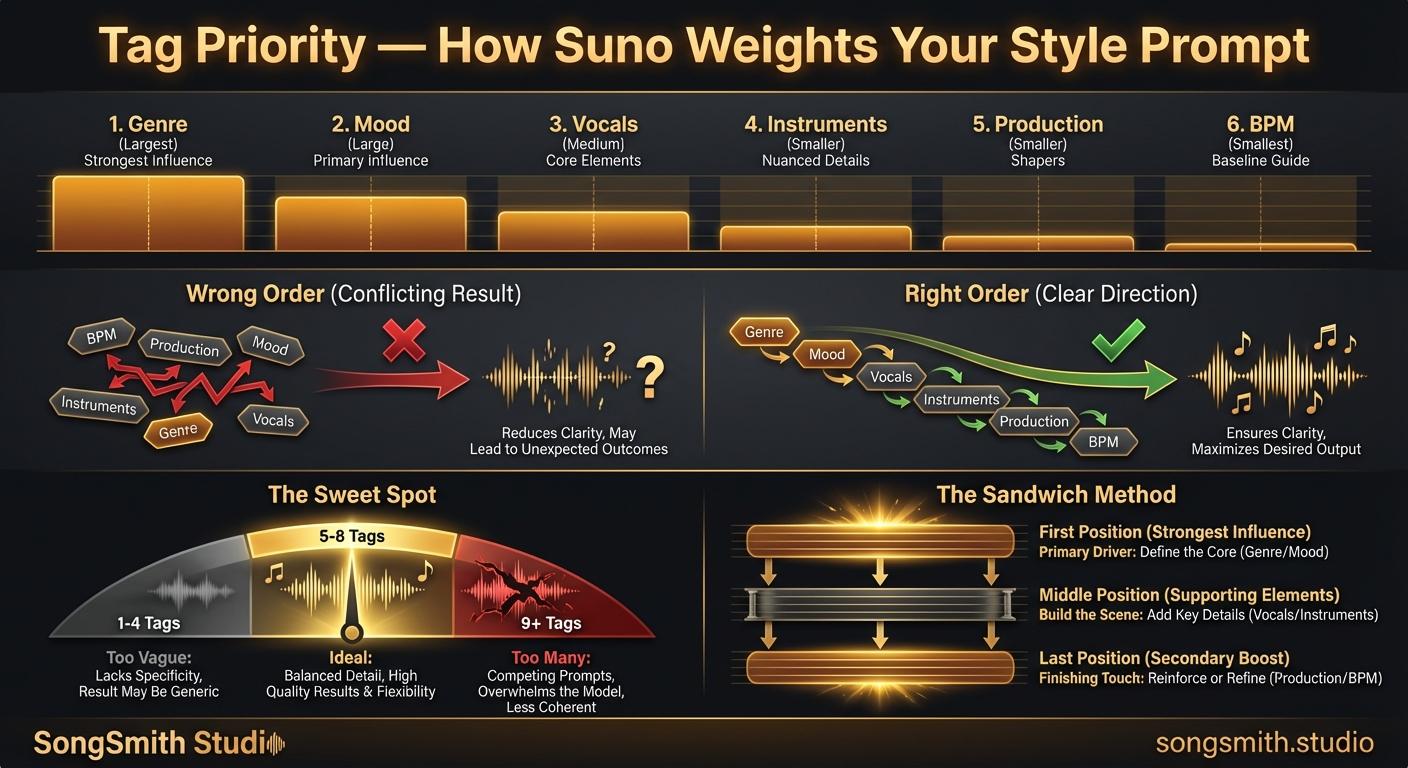
Dark-themed infographic showing horizontal bar chart with tag positions 1-6 and decreasing bar sizes representing influence percentages. Position 1 Genre (largest, amber), Position 2 Mood (large), Position 3 Vocals (medium), Position 4 Instruments (smaller), Position 5 Production (smaller), Position 6 BPM (smallest). Middle section shows side-by-side wrong vs right order examples with the same tags rearranged — wrong order has red X, right order has green check. Bottom shows "The Sweet Spot" meter: 1-4 tags (too vague), 5-8 tags (ideal, highlighted in gold), 9+ tags (too many, conflicting).
Prompting & Style

Tag Priority — How Suno Weights Your Style Prompt

Learn how Suno weights style prompt positions. First tag = 30% influence. Optimal order: genre, mood, vocals, instruments, production, BPM.

3 min read
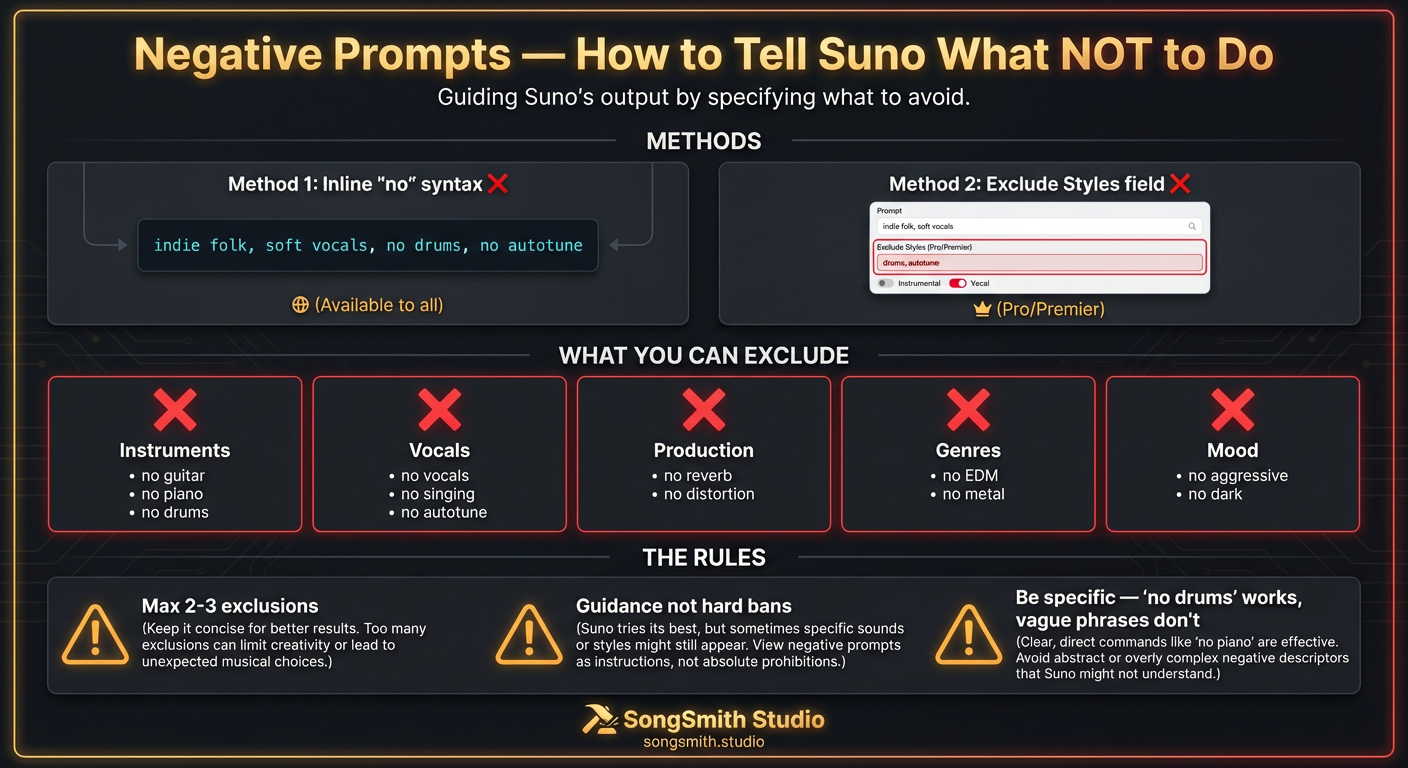
Dark-themed cheat sheet with two method cards at top: Method 1 shows 'Inline no syntax' example in code box with indie folk, soft vocals, no drums, no autotune. Method 2 shows 'Exclude Styles field' with Pro/Premier UI mockup. Middle section shows 5-column grid of exclusion categories with red X icons: Instruments, Vocals, Production, Genres, Mood. Each cell lists specific exclusion examples. Bottom section shows The Rules with 3 key points and warning icons: Max 2-3 exclusions, Guidance not hard bans, Be specific — no drums works, vague phrases don't.
Prompting & Style

Negative Prompts — How to Tell Suno What NOT to Do

Master Suno negative prompts with 'no' syntax. Exclude instruments, vocals, production, genres. Best practices and working exclusion combinations.

2 min read
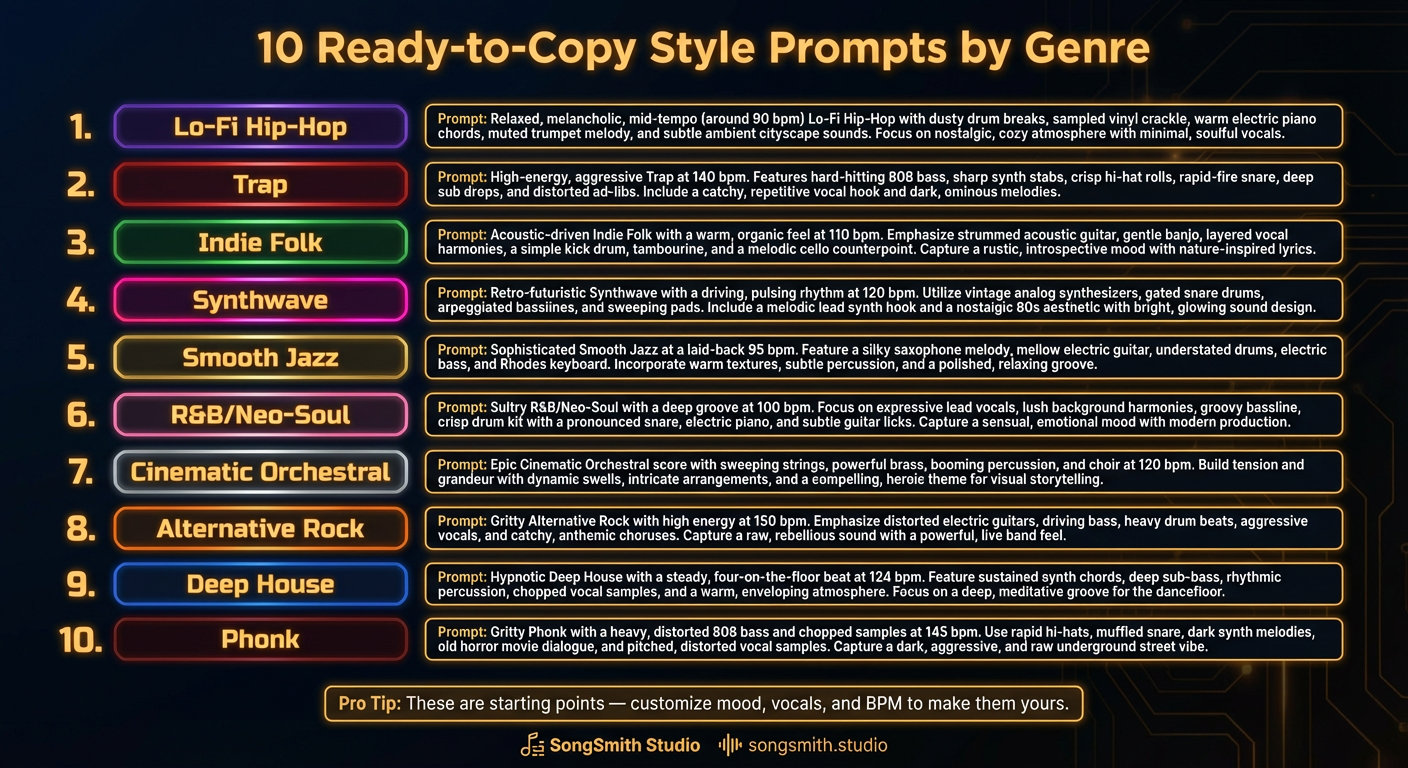
Dark-themed cheat sheet with 10 numbered rows, each showing a genre badge in amber text and the complete style prompt in a code-style monospace box. Genres: 1. Lo-Fi Hip-Hop (purple accent), 2. Trap (red accent), 3. Indie Folk (green accent), 4. Synthwave (neon accent), 5. Smooth Jazz (gold accent), 6. R&B/Neo-Soul (pink accent), 7. Cinematic Orchestral (silver accent), 8. Alternative Rock (orange accent), 9. Deep House (blue accent), 10. Phonk (dark red accent). Each prompt is ready to copy-paste. Bottom shows pro tip: These are starting points — customize mood, vocals, and BPM to make them yours.
Prompting & Style

10 Ready-to-Copy Style Prompts by Genre

Copy 10 battle-tested Suno style prompt templates: lo-fi, trap, indie folk, synthwave, smooth jazz, neo-soul, orchestral, alt rock, deep house, phonk.

3 min read
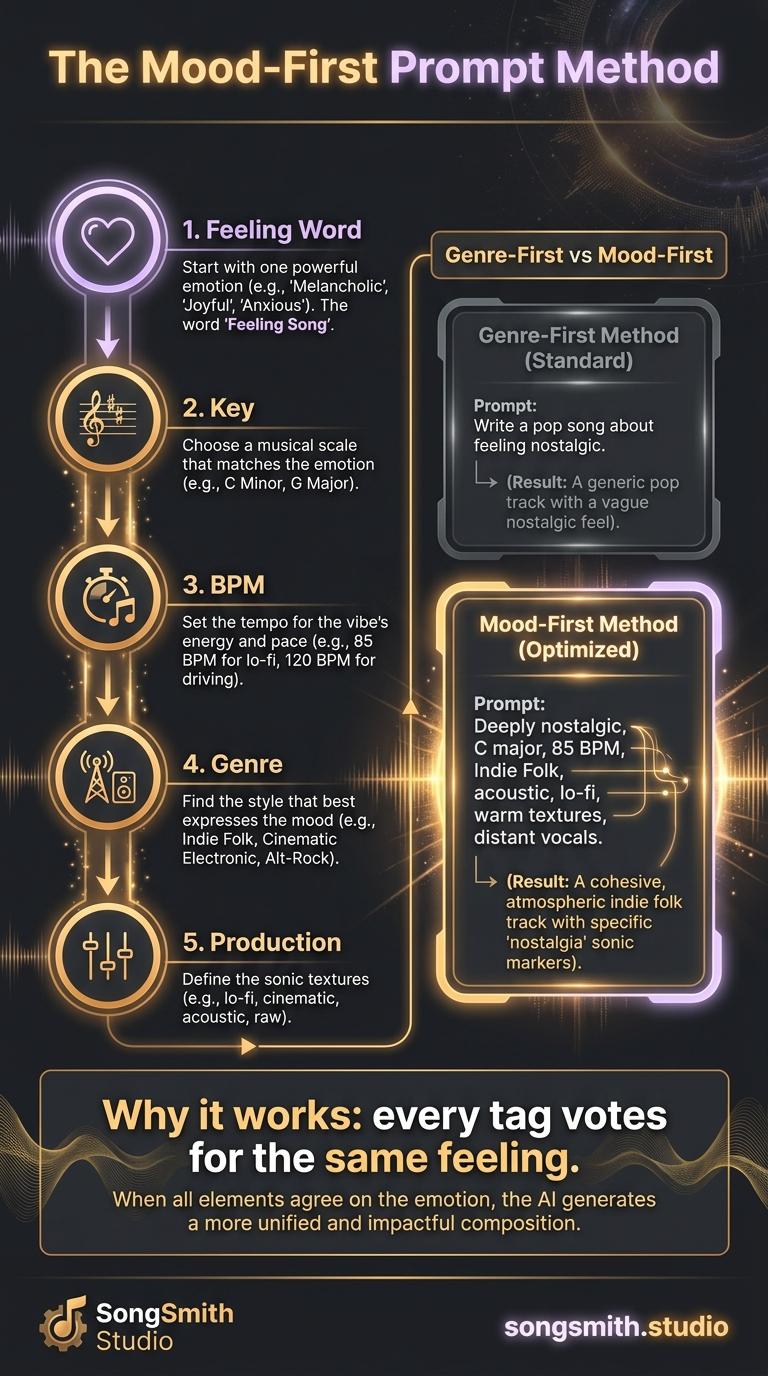
Vertical 5-step flow diagram (Feeling Word → Key → BPM → Genre → Production) on the left with a side-by-side comparison of genre-first vs mood-first style prompts on the right, amber/gold accents on the winning mood-first version.
Prompting & Style

The Mood-First Prompt Method — Reverse the Suno Formula

Stop starting Suno prompts with genre. Lead with mood, key, and BPM instead — and watch coherence and emotional impact jump. Full method + before/after example.

3 min read
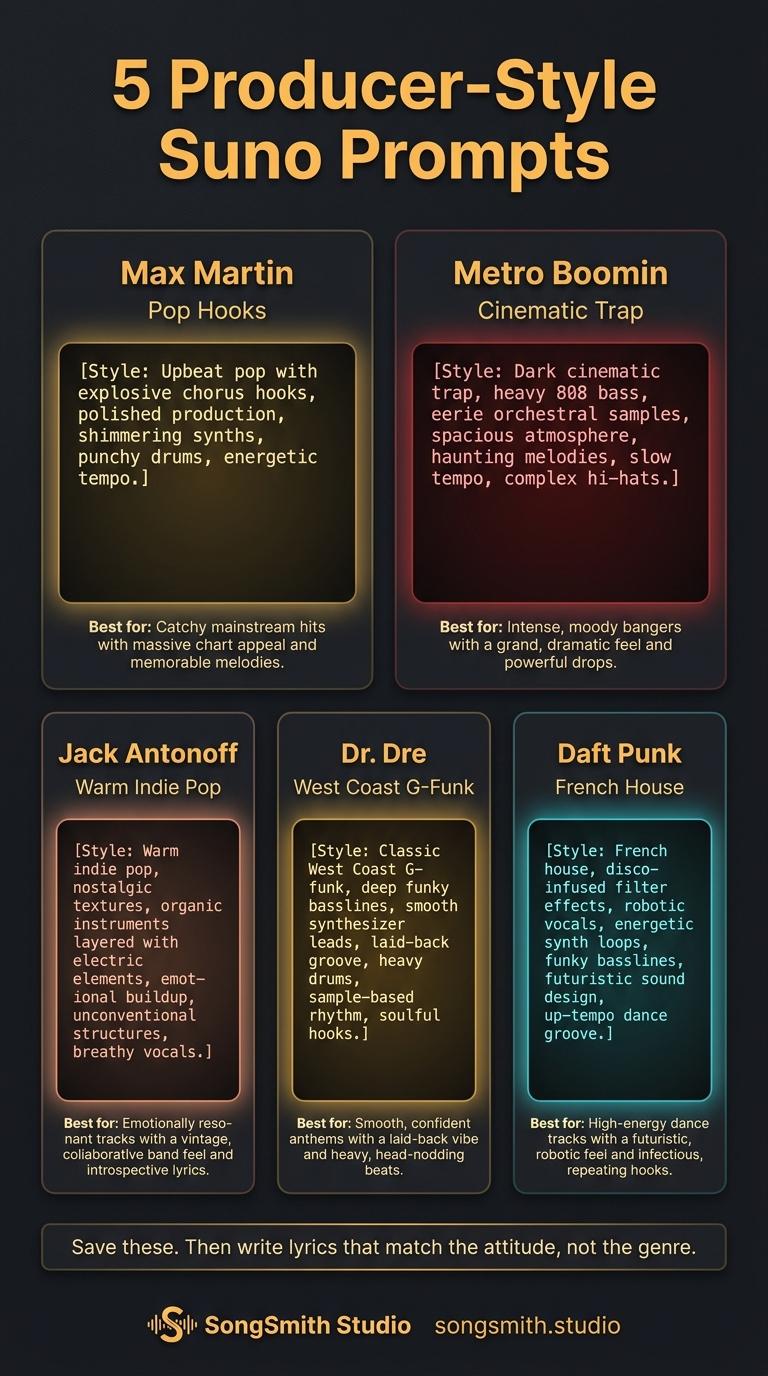
Five vertical templates infographic: each card shows a producer name in bold (Max Martin, Metro Boomin, Jack Antonoff, Dr. Dre, Daft Punk), the genre subtitle, and the full style prompt in a code-block, with a Best for line at the bottom.
Prompting & Style

5 Producer-Style Suno Prompts (Max Martin, Metro Boomin, Antonoff, Dr. Dre, Daft Punk)

Stop describing genres — describe producers. 5 copy-paste Suno style prompts that summon Max Martin pop, Metro Boomin trap, Jack Antonoff indie, Dr. Dre G-funk, and Daft Punk house.

4 min read
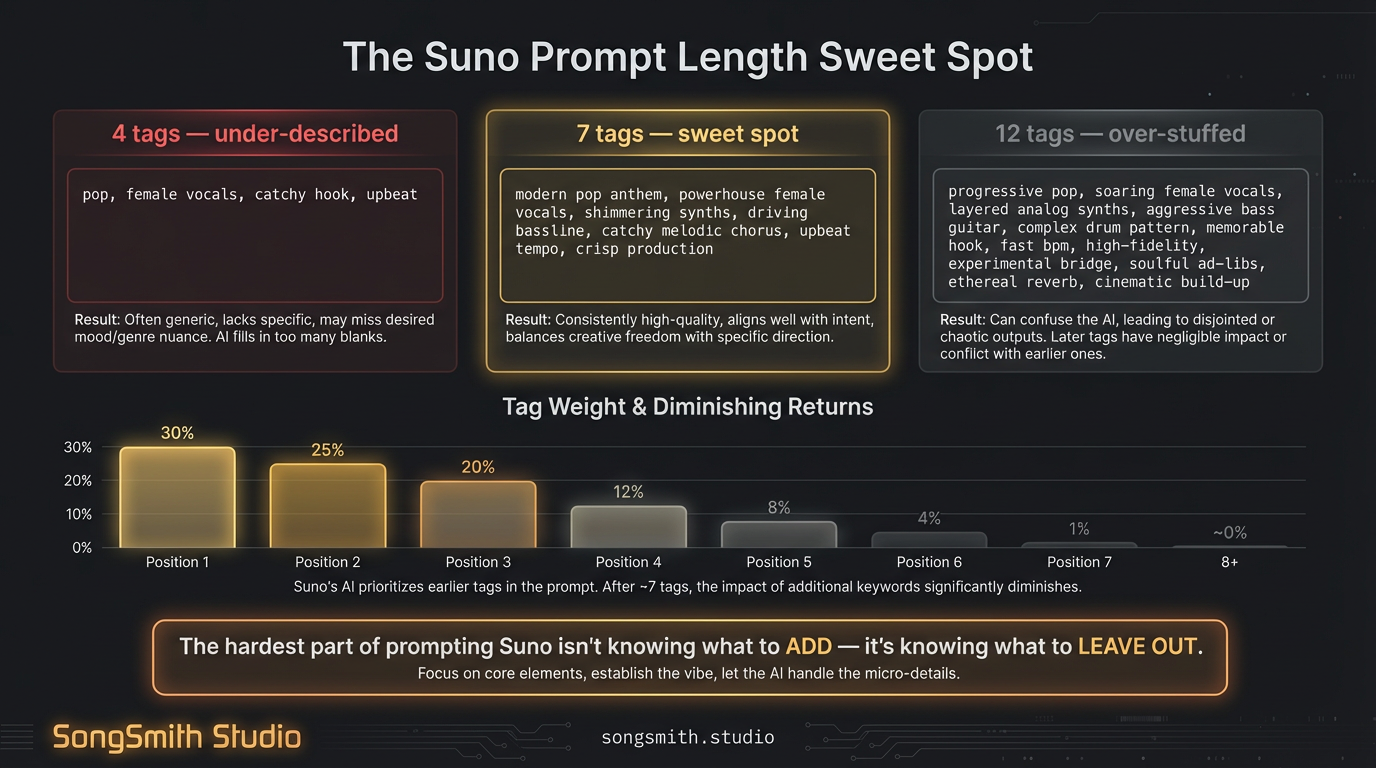
Comparison infographic with three vertical columns showing the same song idea written at 4 tags, 7 tags, and 12 tags. Below the columns, a horizontal Tag Weight bar chart showing diminishing returns from position 1 (30%) to position 8+ (~0%). The 7-tag column is highlighted in amber as the winner.
Prompting & Style

The Suno Prompt Length Sweet Spot — Why 5–8 Tags Beats 12

Long Suno prompts feel detailed but the model only obeys the first ~7 tags. Learn the position-weight math and the 5-8 tag sweet spot — with 4/7/12 tag side-by-side test.

3 min read
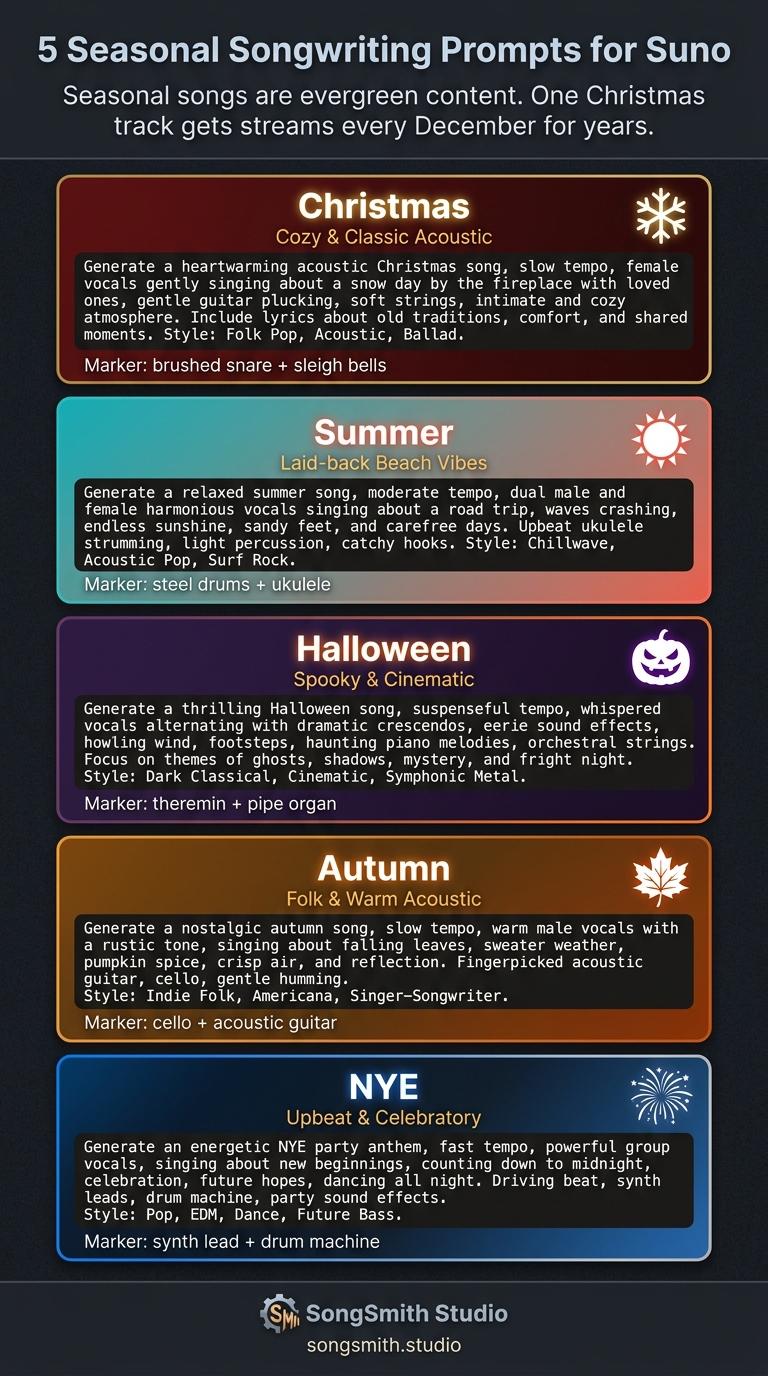
Seasonal templates infographic with 5 vertical season-themed cards (Christmas red/gold, Summer turquoise/coral, Halloween purple/orange, Autumn amber/burnt orange, NYE electric blue/silver). Each card shows the genre subtitle and full style prompt in a code block.
Prompting & Style

5 Seasonal Suno Prompts (Christmas, Summer, Halloween, Autumn, NYE)

Seasonal songs are evergreen content. 5 ready-to-paste Suno style prompts (Christmas vintage jazz, summer surf pop, Halloween cinematic minor, autumn folk, NYE house) with a full Christmas example.

4 min read
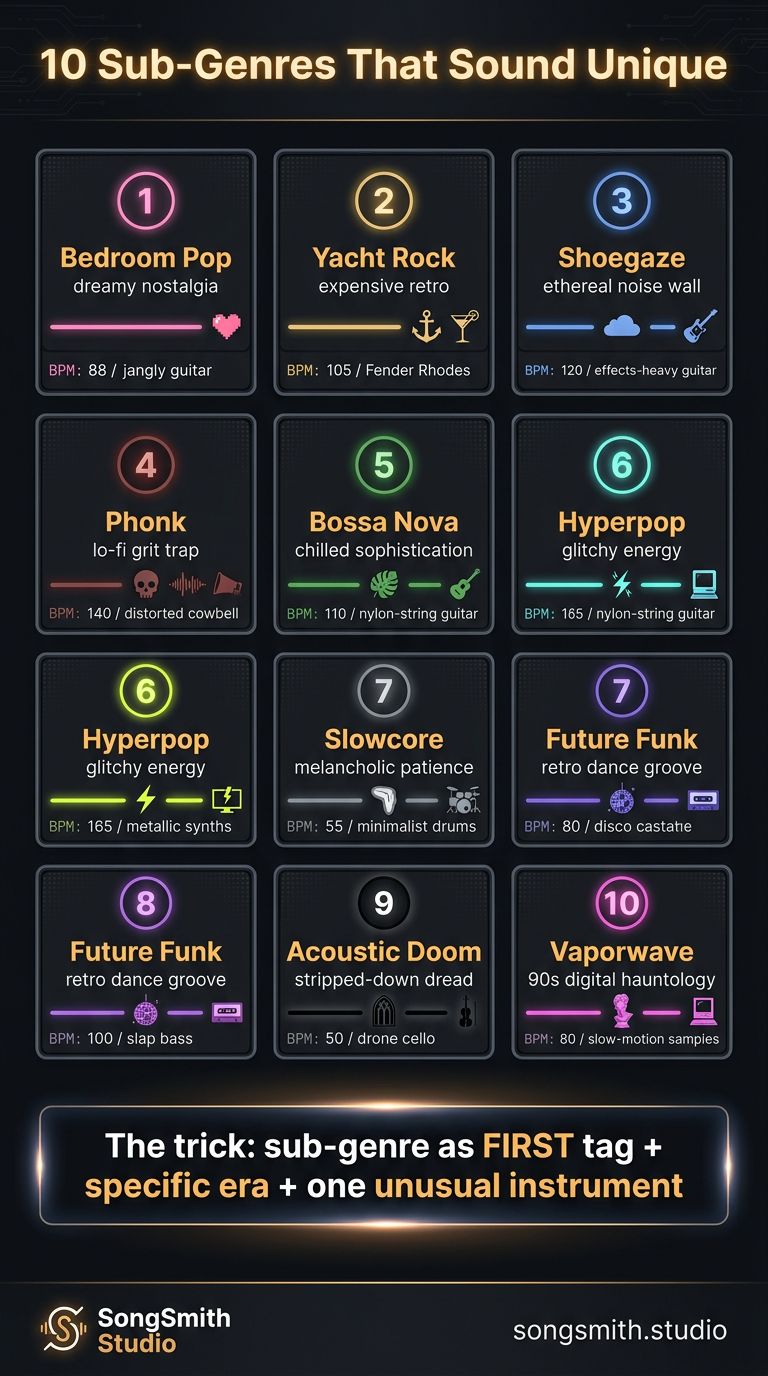
Cheat-sheet infographic listing 10 sub-genre templates in a 2x5 grid, each card with a name in bold amber, vibe descriptor, and BPM + signature instrument snippet.
Prompting & Style

10 Sub-Genre Templates That Sound Unique on Suno (Forget Pop — Try These)

Pop is too broad. 10 ready-to-paste sub-genre templates (bedroom pop, yacht rock, shoegaze, drift phonk, bossa nova, hyperpop, slowcore, future funk, acoustic doom, vaporwave) that produce distinctive results.

2 min read
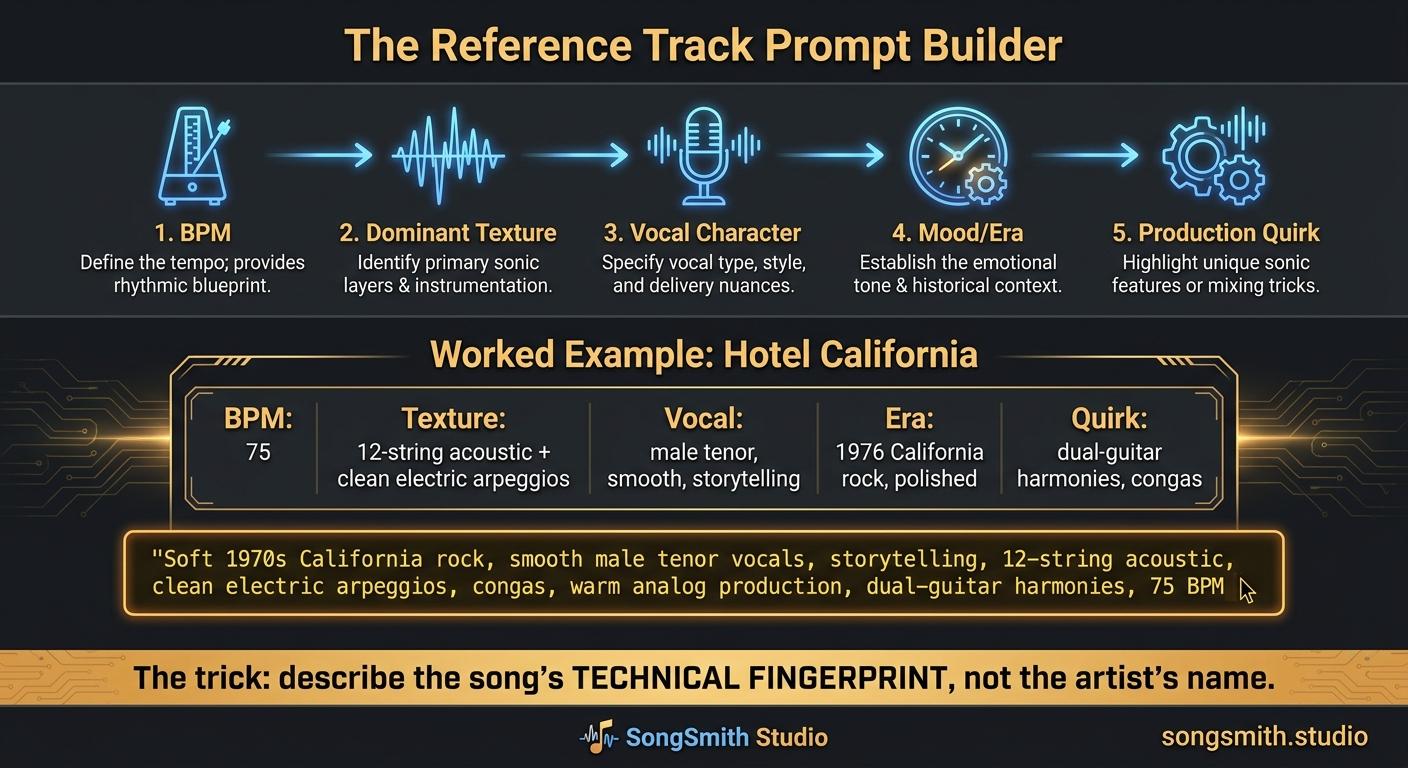
Step-by-step infographic showing the 5-step reference-track decomposition pipeline (BPM, texture, vocal, mood/era, quirk) with a worked Hotel California example and assembled prompt.
Prompting & Style

How to Match Any Song's Vibe Without Naming the Artist on Suno (Reference Track Prompt Builder)

Suno blocks artist names. Reverse-engineer any song's technical fingerprint in 5 steps — BPM, dominant texture, vocal character, mood/era, production quirk — with 3 worked examples.

3 min read
Technique infographic titled 'Pipe Stacking — The | Operator' showing the format [core | era | tone | quirk] with color-coded segments, 5 worked example cards, and a rules callout box.
Prompting & Style

Pipe Stacking on Suno — The | Operator That Turns One Tag Into Producer-Level Control

The pipe operator stacks multiple modifiers into one bracket as a single AND-instruction. Format, rules, 5 worked examples (Classic Rock to Trap), and category-style tag upgrades.

2 min read
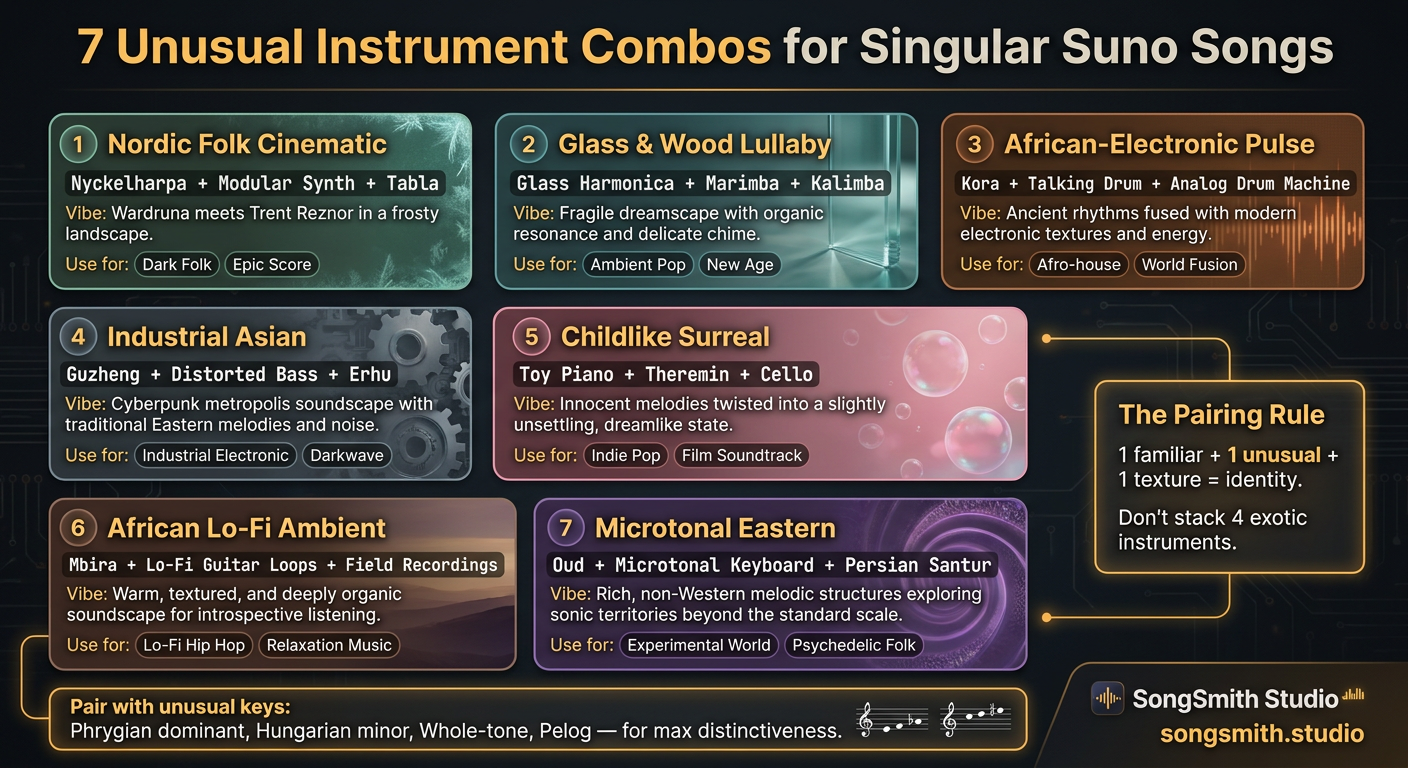
Save-worthy infographic listing 7 unusual instrument combos (Nordic Folk, Glass & Wood Lullaby, African-Electronic, Industrial Asian, Childlike Surreal, African Lo-Fi, Microtonal Eastern) with vibe descriptors.
Prompting & Style

7 Unusual Instrument Combos That Make Suno Sound Like Nothing Else

Most users default to piano + guitar + drums. The top 1% reach for nyckelharpa, glass harmonica, kora, shamisen, mbira, qanun. 7 combos with use cases and pairing rules.

4 min read
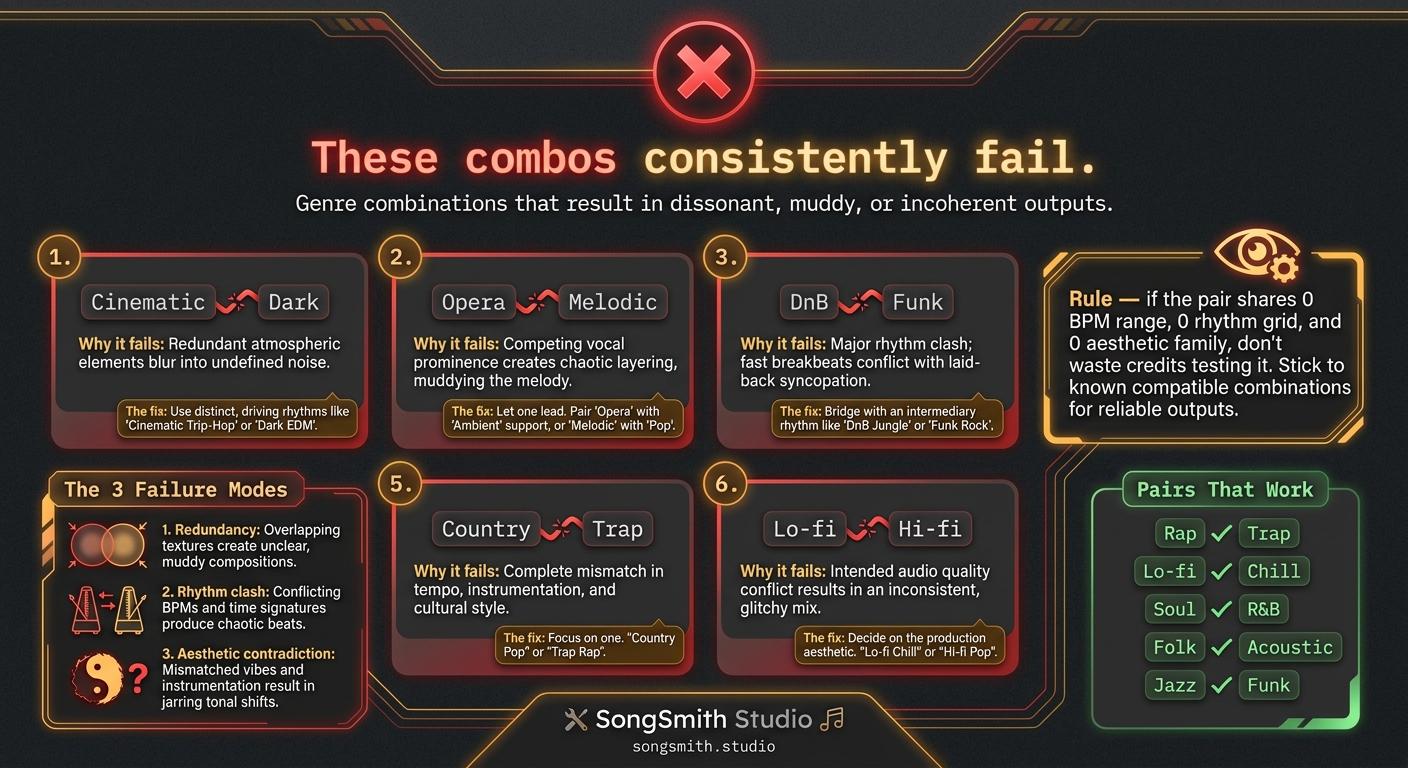
Anti-pattern infographic titled 'Genre Anti-Pairs' with 6 numbered anti-pair cards showing failing genre combos with broken-link visuals, plus 3 failure-mode icons and a 'pairs that work' list.
Prompting & Style

Genre Anti-Pairs — 6 Genre Combos That Sound Like Mush on Suno (And Why)

Some genre combos fail every time on Suno. 6 anti-pairs (Cinematic+Dark, Opera+Melodic, DnB+Funk, Ambient+Trap, Country+Trap, Lo-fi+Hi-fi) with the 3 failure modes that explain why.

4 min read
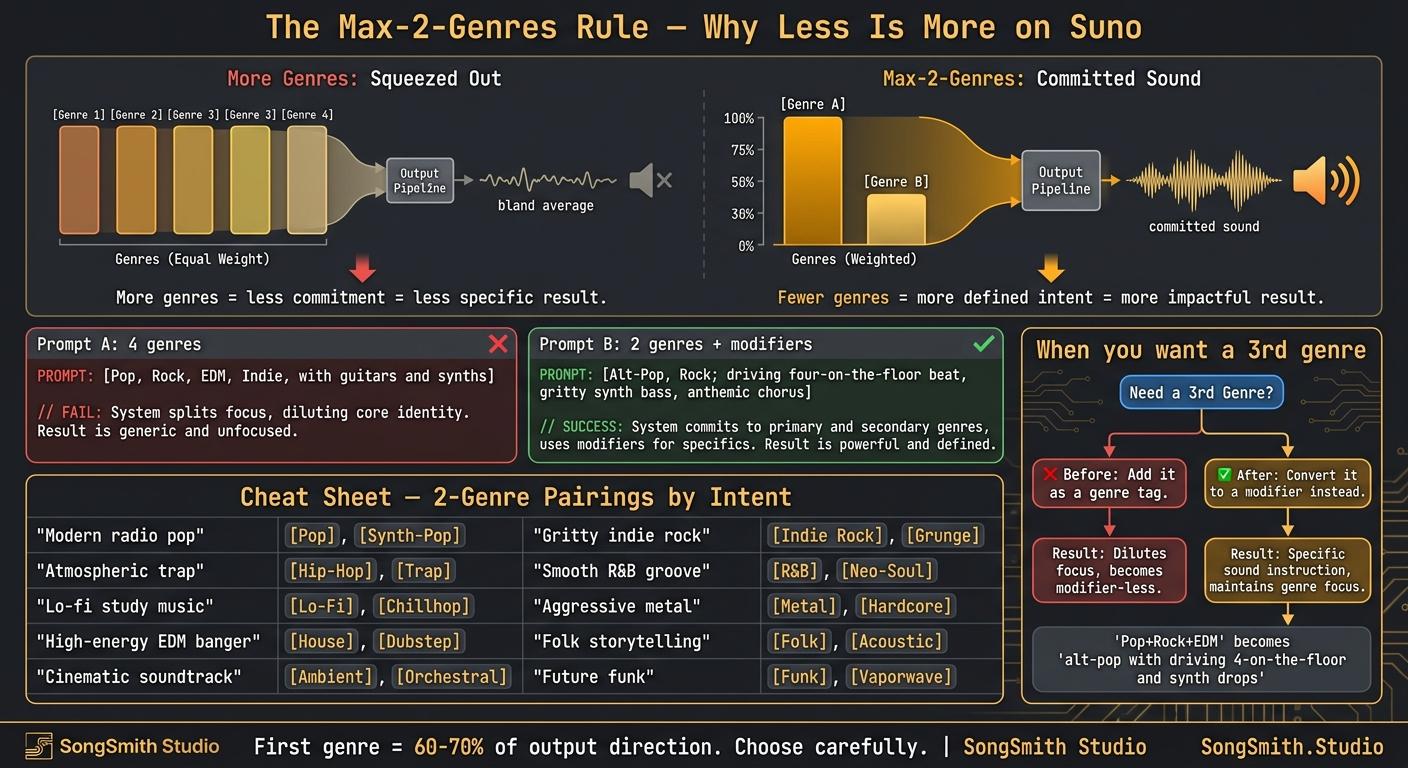
Educational infographic titled 'The Max-2-Genres Rule' with a probability/weight visualization, side-by-side Prompt A vs Prompt B comparison, and a 10-vibe pairing cheat sheet.
Prompting & Style

The Max-2-Genres Rule on Suno — Why Pop, Rock, EDM, Trap Fails Every Time

Genre tags are probability weights, not ingredients. Why 3+ genres dilute Suno's commitment, the side-by-side proof, and a 10-vibe cheat sheet of 2-genre pairings by intent.

4 min read
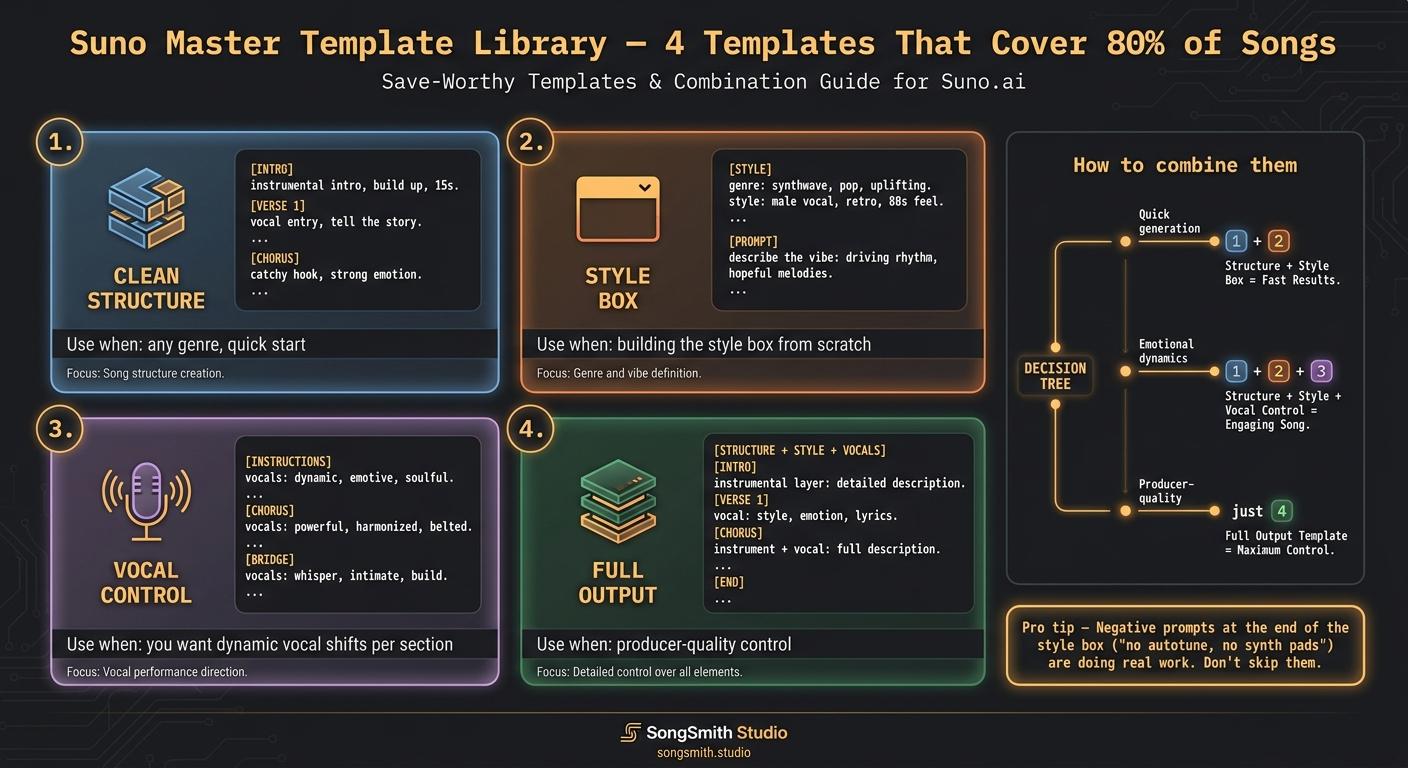
Save-worthy infographic titled 'Suno Master Template Library' with 4 large template cards (Clean Structure, Style Box, Vocal Control, Full Output) each with code-style snippets and 'Use when' guidance.
Prompting & Style

The Suno Master Template Library — Style Box, Vocal Control, Full Output (Save These 4 Templates)

Four reusable Suno templates that cover 80% of songs: Clean Structure, Style Box, Vocal Control, Full Output (with pipe-stacked sections). Copy-paste, fill the placeholders, generate.

5 min read