How to Write Lyrics for Suno That Actually Sound Like Real Songs
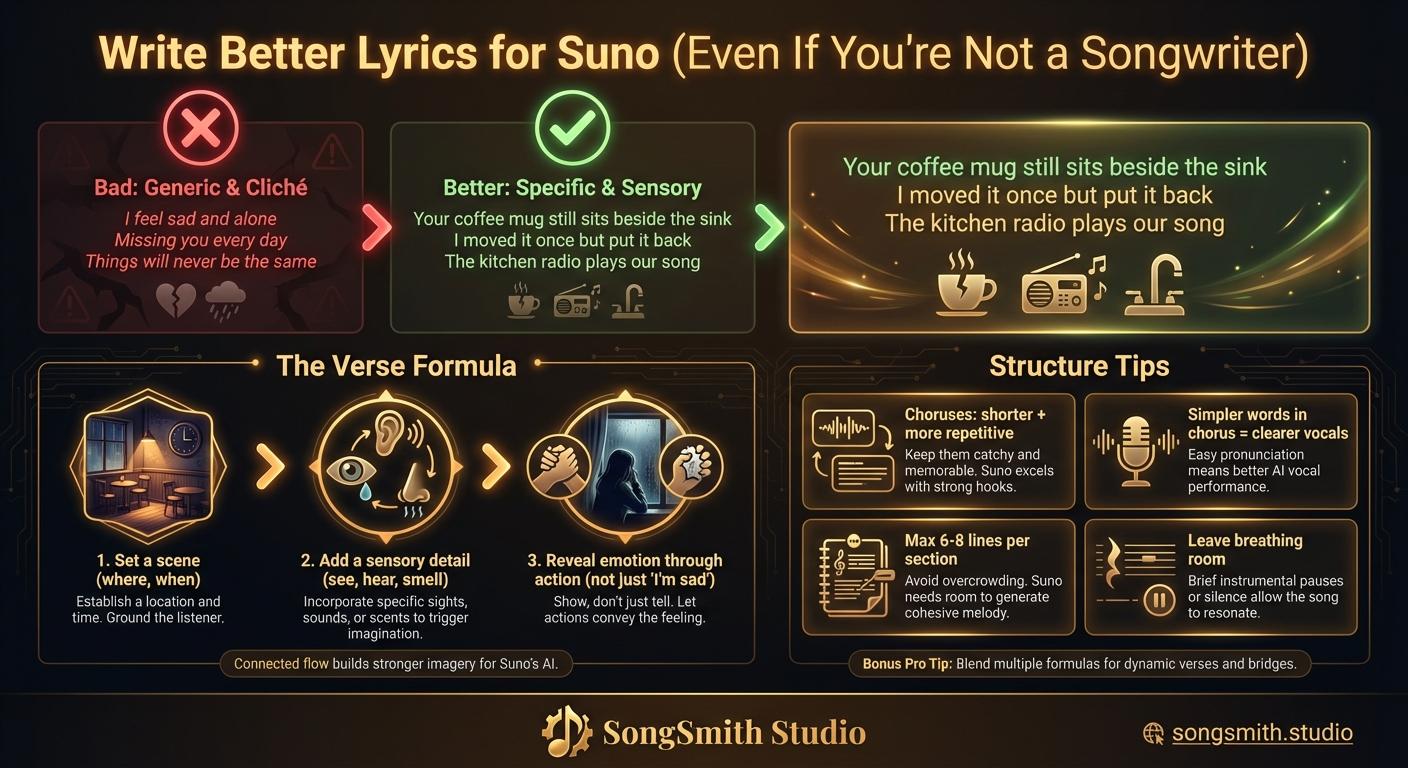
The #1 thing that separates great Suno songs from forgettable ones isn't the style prompt. It's the lyrics. You don't need to be a poet. You just need to be specific. After reviewing thousands of songs created with Suno, the pattern is crystal clear: songs with vivid, concrete details sound infinitely more real than songs with vague emotional statements.
Specificity Creates Imagery, Imagery Creates Emotion
Here's the core principle: instead of telling Suno (and your listener) what you feel, show them a scene. Let them infer the emotion from the details.
Bad lyrics (vague):
I feel sad and alone
Missing you every day
Things will never be the same
Better lyrics (specific):
Your coffee mug still sits beside the sink
I moved it once but put it back
The kitchen radio plays our song
I let it finish before I switch it off
The second version doesn't say "I'm sad." But anyone who reads it *feels* the sadness. That's the power of specificity.
The Verse Formula (The Quick Win)
If you're stuck on how to structure your lyrics, use this 3-step formula for each verse:
- Set a scene: Where are you? When is this happening? Ground the listener in a specific moment.
- Add a sensory detail: What do you see, hear, smell, or feel? Pick one specific thing, not everything.
- Reveal emotion through action, Instead of stating "I'm sad," show an action that reveals it. (Moving the mug back, letting the song finish, etc.)
Structure Tips for Better Suno Vocals
- Choruses should be shorter and more repetitive than verses: Suno handles repetition better than complex lyrics; simple, memorable phrases stick in the listener's head
- Use simpler words in the chorus: They're easier for Suno to pronounce and sing clearly. Avoid multisyllabic words in the hook.
- Don't write more than 6-8 lines per section: Long, dense verse sections get rushed or mumbled by the AI vocalist
- Leave breathing room: Not every line needs to be packed with words. Short, punchy lines alternate with longer ones so Suno has room to breathe musically.
Using AI to Help (Not Replace) Your Lyrics
There's no shame in using ChatGPT, Claude, or other AI to help draft lyrics. The trick is to then edit them with your specific details. Replace generic lines with personal ones.
Here's my workflow: I use AI to generate a first draft based on a theme, then rewrite 30-50% of it with specific imagery. The AI gives structure, I give soul. This hybrid approach lets you move fast without sacrificing authenticity.
Pro tip: If you're drawing from a real memory or emotion, that specificity will bleed through even with AI-assisted lyrics. "Our coffee mug by the sink" is a detail only you know.
Practical Example: Before and After
Let's say you want to write a breakup song. Here's a generic first draft:
[Verse]
You're gone now
I'm all alone
Missing what we had

[Chorus]
I'm broken, I'm blue
Don't know what to do
I loved you true
Now let's add specificity:
[Verse]
Your jacket's still hanging by the door
I drove past your street today
The coffee shop where we first met
Has a new song on the speaker

[Chorus]
I'm learning to walk alone
Throughout this empty home
Your ghost in every room
See the difference? The second version paints a picture instead of broadcasting feelings. Suno will deliver much stronger vocals because the AI has real imagery to work with.
The Bottom Line
Better Suno lyrics come down to one thing: specificity over emotion statements. Write like you're telling a friend a story, not like you're summarizing a feeling. Use sensory details, concrete scenes, and actions instead of adjectives. Your songs will sound real, feel authentic, and get way more miles out of Suno's AI vocalist.
AI-generated lyrics with structure built in
SongSmith generates complete lyrics with [Verse], [Chorus], and [Bridge] tags already in place — ready for Suno Custom Mode.
Get started freeKeep reading
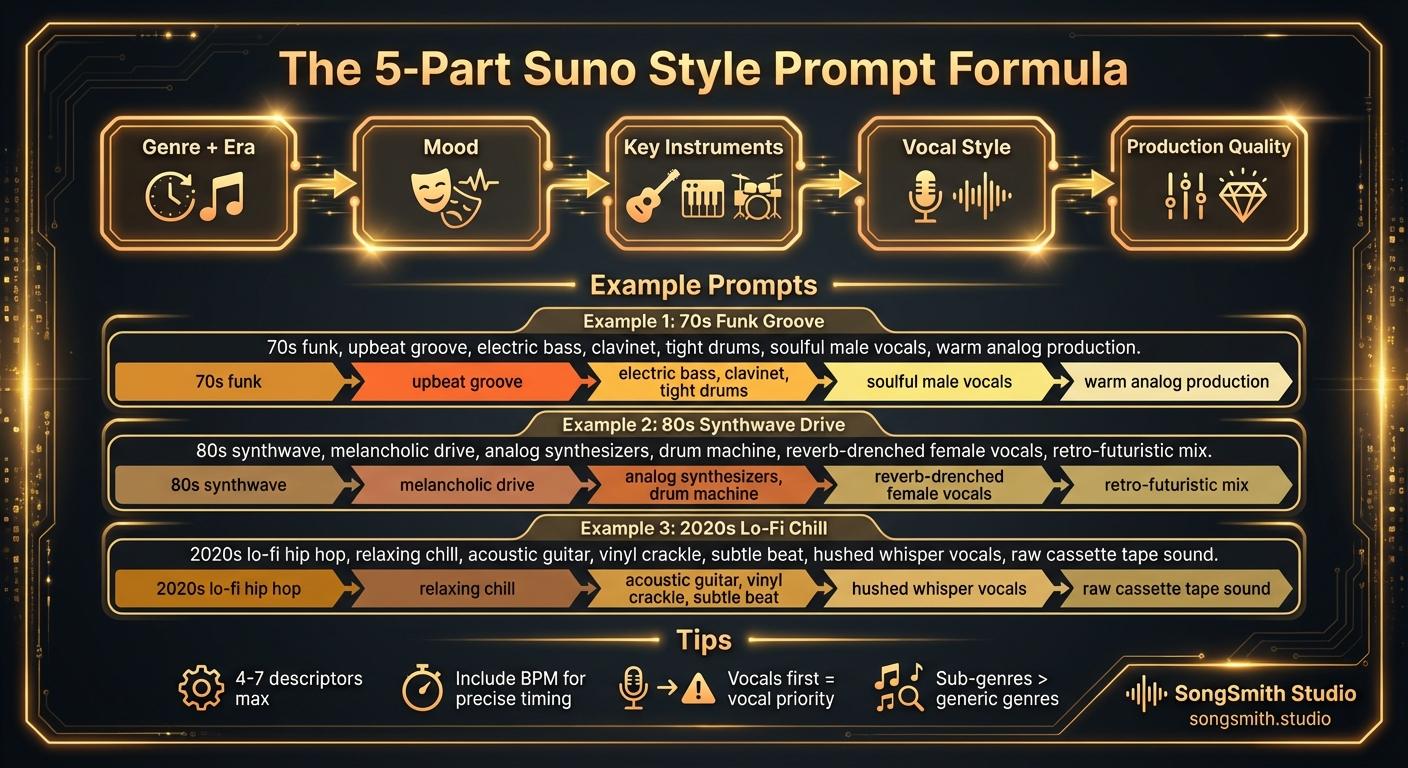
Craft Precise Style Prompts Using This Battle-Tested Formula
Master the 5-part formula for Suno style prompts: Genre + Era, Mood, Instruments, Vocal Style, Production. Learn tips for better results and example prompts that work.
2 min read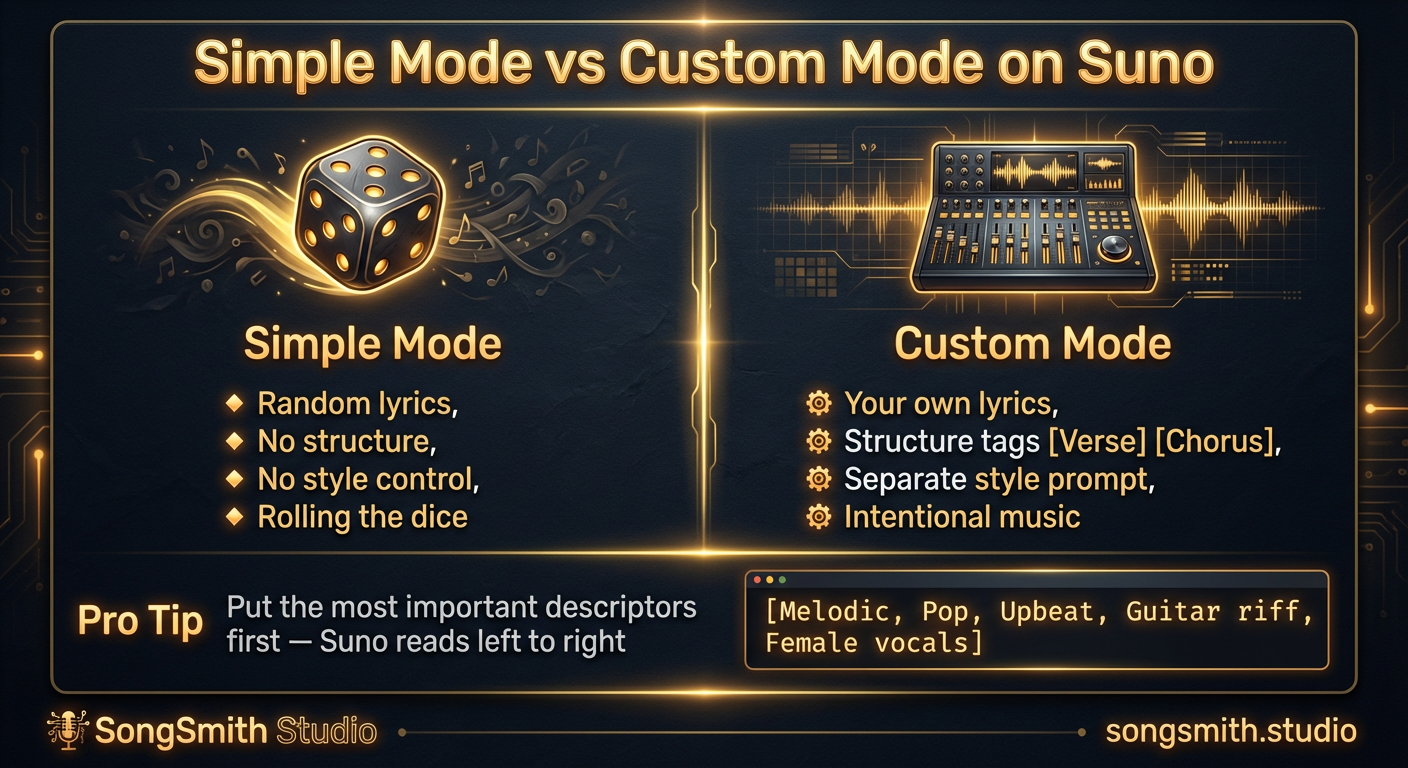
Why Custom Mode Gives You Total Control Over Your Suno Songs
Learn why Simple Mode limits your Suno songs. Switch to Custom Mode to write your own lyrics, control structure, and get intentional music instead of random results.
2 min read