The Bridge Builder: Make [Bridge] Sections Land Every Time on Suno
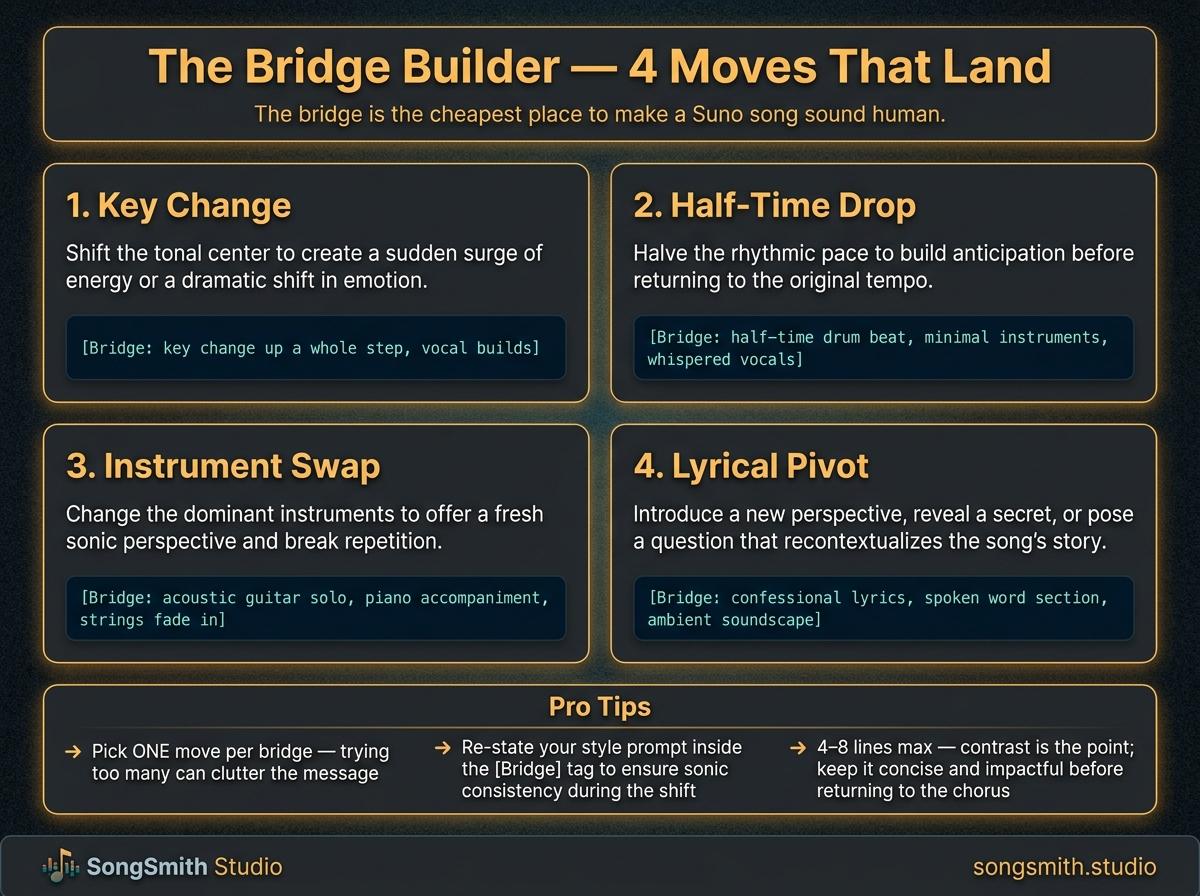
A bridge has one job: change the energy enough that when the final chorus hits, it lands like a punchline. Suno's default bridge is just "the chorus, but quieter, with a slightly different chord", and that's the part where AI songs sound most like AI. There are 4 reliable moves Suno responds to. Pick one per song; combining them creates noise, not contrast.
Why Most Suno Bridges Fall Flat
Without explicit instruction, Suno treats the bridge as a slight harmonic detour from the chorus. The melody changes a bit, the lyrics change, but the *energy* stays roughly identical. The result: a section that adds length without adding contrast, which means the final chorus has nothing to land *against*. The fix is to tell Suno to do *one specific structural thing* in the bridge.
Move 1: The Key Change
Modulate up a whole step (the cheap-but-effective pop move) or down a minor third (the moody, cinematic move). Suno honors key changes when you label them in the section tag.
[Bridge: key change up a whole step, vocal builds intensity]Why it works: a key change forces every melody note into new territory. Listeners feel "we went somewhere" without consciously knowing why.
Move 2: The Half-Time Drop
Cut the perceived tempo in half by halving the snare cadence. Same BPM, completely different feel. Massive in trap, hip-hop, and modern pop, a staple of the modern bridge.
[Bridge: half-time feel, snare on 3 only, vocal slows]Why it works: the body relaxes during the bridge, which makes the return-to-tempo on the final chorus feel like a launch.
Move 3: The Instrument Swap
Strip the production. Drop the drums entirely. Add one new instrument that hasn't appeared yet: solo piano, fingerpicked acoustic, lone cello. This is the highest impact-per-effort bridge move.
[Bridge: solo piano only, no drums, no bass, vocal close-mic]Why it works: removing instruments creates contrast cheaper than adding them. The ear notices absence faster than presence.
Move 4: The Lyrical Pivot
Same instrumentation, but the *speaker* changes. The verses were "I"; the bridge is "you" or "we." Or the whole bridge is one direct address: to the person you've been singing about, to the listener, to your past self.
[Bridge]
And to the version of me who wrote the first verse,
You were right to be afraid
You were right to keep score
You were right to wait for the door to close
Before you finally walked through
Why it works: the perspective shift creates a meta-moment without changing a single chord. It feels like the song stepped outside itself for a second.
Pro Tips for All 4 Moves
- Always re-state your style prompt inside the bridge tag. Suno drifts hardest in bridges. Example:
[Bridge: indie folk, fingerpicked acoustic, intimate, half-time feel] - Punctuation matters more here than anywhere else. A period after a bridge line gives Suno permission to *land* on that note instead of rushing into the next.
- Keep bridges short: 4 to 8 lines max. The contrast is the point; a long bridge is just a second verse.
- The last line of the bridge should rhyme into (or sonically lead to) the first word of the final chorus. Suno will often pick this up and add a vocal lift.
- Pick one move per bridge. Combining a key change + half-time + instrument swap is too much information at once and Suno will pick its favorite.
How to Use the Bridge Builder
Try the Instrument Swap on your next song. It's the move with the highest impact-per-effort ratio. Here's a complete bridge block to drop into your lyrics:
Style Prompt (Kept Consistent Across the Song)
indie folk, melancholic, fingerpicked acoustic and warm pad, breathy male vocal, lo-fi tape warmth, 86 BPMBridge Block
[Bridge: solo piano only, no drums, no bass, vocal close-mic, intimate]
I'm not sure who I was writing this for
Maybe the version of you who answered the door
Maybe the version of me who never asked
Either way: the song is almost past
Then Return to the Final Chorus
[Final Chorus: full band returns, vocal stack, soaring]The contrast between the stripped piano-only bridge and the full-band final chorus does the work. You don't need to make the chorus louder, just make the bridge quieter.
The Bridge Is Where Songs Stop Sounding Like AI
Most listeners can't articulate *why* an AI song sounds like an AI song, but the bridge is usually where the feeling crystallizes. A song that takes a structural risk in the bridge feels human even when every other element is generated. Pick a move and use it.
AI-generated lyrics with structure built in
SongSmith generates complete lyrics with [Verse], [Chorus], and [Bridge] tags already in place — ready for Suno Custom Mode.
Get started freeKeep reading
![Three-column cheat sheet showing all Suno structure tags: Structure column with [Intro], [Verse], [Chorus], [Bridge], [Outro], [Break], [Interlude]. Vocal Delivery column with [Whispered], [Spoken Word], [Belted], [Falsetto], [Harmonized], [Ad-lib]. Instrumental column with [Instrumental], [Guitar Solo], [Piano Solo], [Drop]. Bottom shows a perfect song template flowchart.](/_next/image?url=%2Fblog%2F03-suno-structure-tags-cheat-sheet.jpeg&w=3840&q=75)
Master Every Suno Structure Tag for Professional Song Organization
Complete reference of Suno structure tags: [Verse], [Chorus], [Bridge], [Intro], [Outro], vocal delivery tags, and instrumental tags. Save this cheat sheet for every session.
3 min read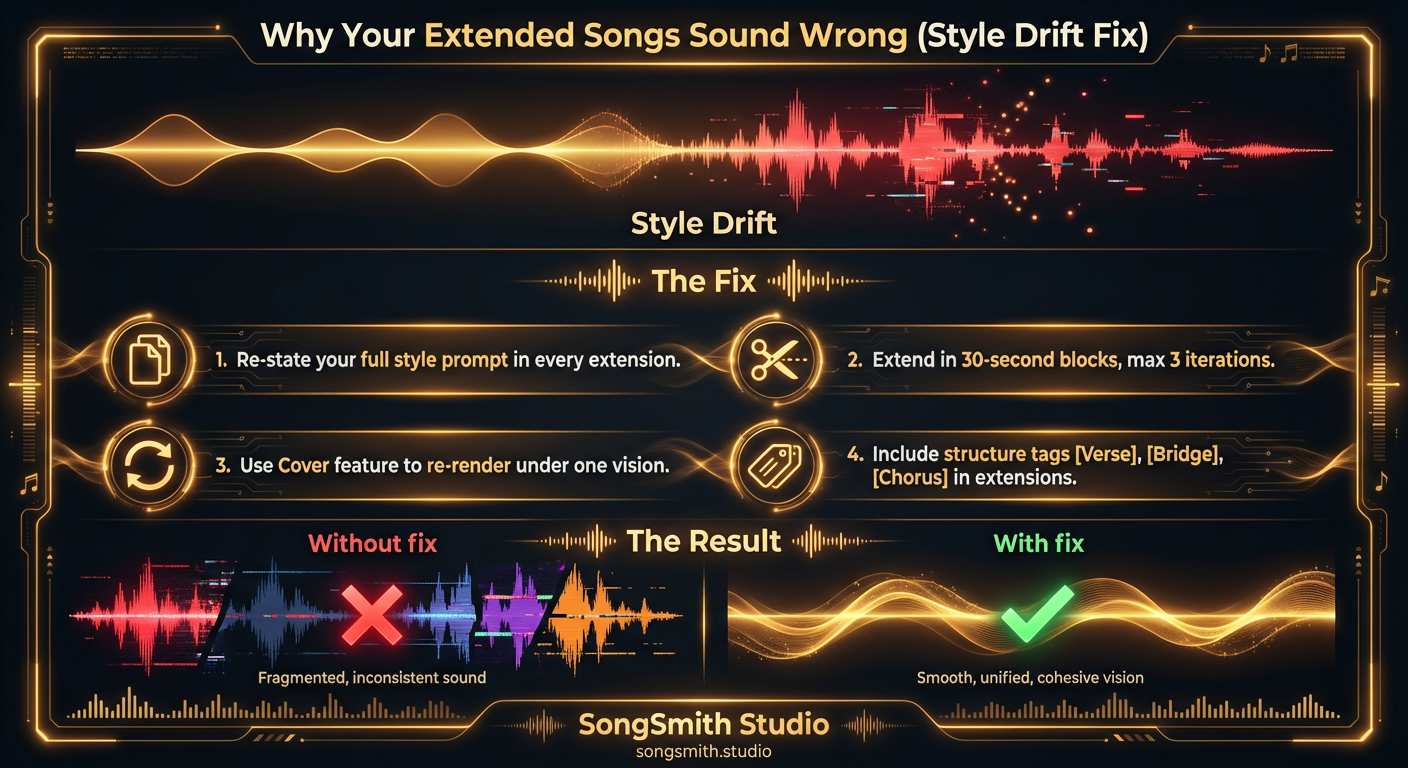
Why Your Extended Songs Sound Wrong (and How to Fix Style Drift)
Style drift ruins extended songs on Suno. Learn why extensions sound different and four proven fixes to maintain consistent sound across full-length tracks.
4 min read![Dark-themed cheat sheet showing 5 target song durations (2:00, 2:30, 3:00, 3:30, 4:00) stacked as horizontal rows. Each row shows an amber duration badge, a subtitle label, and a colored block diagram representing the song structure with intro, verses, pre-chorus, chorus, bridge, and outro sections. Each section is a different color. Intro gray, verse blue, pre-chorus teal, chorus gold, bridge purple, outro dark red. Bottom strip shows line-timing reference: 4-line verse ≈ 15s, chorus ≈ 15–18s, bridge ≈ 18–25s. Footer tip: Always use an explicit [Outro: X bars], never [End].](/_next/image?url=%2Fblog%2F33-suno-song-length-formula.jpeg&w=3840&q=75)
Song Length Formula: Exactly How to Hit 2:00, 3:00, 3:30, 4:00
Stop getting songs that cut off before the last chorus. Use these exact section structures and line counts to hit any target duration on Suno with near-perfect accuracy.
3 min read