Pipe Stacking on Suno: The | Operator That Turns One Tag Into Producer-Level Control
![Technique infographic titled 'Pipe Stacking: The | Operator' showing the format [core | era | tone | quirk] with color-coded segments, 5 worked example cards, and a rules callout box.](/_next/image?url=%2Fblog%2F56-suno-pipe-stacking-masterclass.png&w=3840&q=75)
Most prompts look like this:
[Verse] [anthemic chorus] [80s glam metal]
Flat. Single-concept. Suno reads them as isolated tags.
Pros stack them with the | pipe inside a single bracket. Each pipe is an AND operator. Suno reads the whole thing as one tightly-bound instruction.
The format:
[core element | era/genre | tone/mix | quirk detail]The rules:
- Lead with the core element or the section label
- Max 4–6 modifiers per stack: more and it turns to noise
- Use era anchors for genre accuracy (60s, 80s, 90s)
- Each section gets its own stack. Don't reuse one bracket across the song
- Lowercase inside the bracket is fine; consistency matters more than caps
5 worked examples that consistently produce clean results:
1. Classic Rock verse
[Verse | 60s jangly guitar rhythm | clean Fender tone | bright treble EQ | light spring reverb]2. Glam Metal guitar solo
[Guitar solo | 80s glam metal lead guitar | heavy distortion | pinch harmonics | wide stereo]3. EDM drop
[Drop | sidechained synth bass | layered white noise riser | sub drop impact | stereo delay tail]4. Modern Pop chorus
[Chorus | anthemic chorus | stacked harmonies | modern pop polish | bass drop]5. Trap verse
[Verse | autotuned delivery | tuned male vocal | light reverb | stereo slapback]Notice the pattern: section name first, then era or genre anchor, then mix character, then one quirk that makes it specific.
The category-style upgrade:
You can also use category tags as the lead. Useful when you want to package multiple cues into one role:
[Instrumentation: overdriven punk guitar | palm-muted power chords | fast downstrokes]
[Vocal: raspy lead vocal | gang shouts on last line]
[Mix: mono bass, stereo guitar | slight room reverb]
This works because Suno reads the whole stack as belonging to that category, so "Instrumentation:" scopes everything that follows to instrument tags, not arrangement.
Why this beats flat tags:
Flat tags compete for attention. Stacked tags reinforce each other. When you write 80s glam metal lead guitar | pinch harmonics | whammy bar bends | heavy distortion, Suno doesn't pick one. It weights them as a single coherent style cluster.
Pro tips:
- Don't pipe-stack across sections, one section, one bracket. The instruction loses focus if you stuff a Verse + Chorus into the same stack.
- Order matters inside the stack. First element = highest weight.
- Avoid stacking contradictory modifiers (
dry punchy | reverb-drenchedcancels itself out). - If a stacked bracket isn't landing, peel back to 3 modifiers, sometimes less is more.
- Combine with negative prompts at the end of the style box: pipe-stacked sections + "no autotune, no synth pads" final line.
Save this. What's the most useful pipe-stack you've discovered? Drop your bracket below and I'll tell you what Suno's likely doing with it.
Create your first Suno album on SongSmith
From a single idea to a complete, YouTube-ready album. AI lyrics, Suno automation, album art, and video rendering — all in one workflow.
Get started freeKeep reading
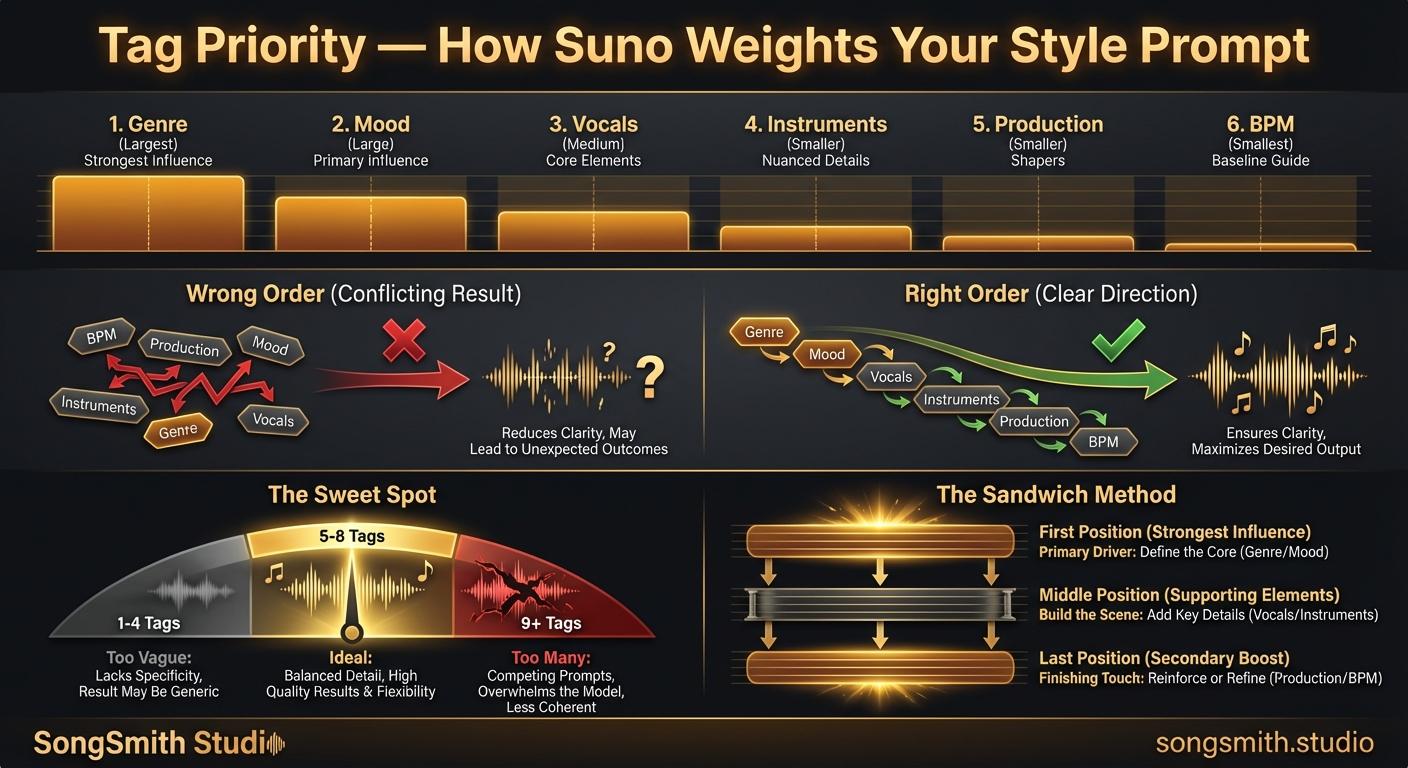
Tag Priority: How Suno Weights Your Style Prompt
Learn how Suno weights style prompt positions. First tag = 30% influence. Optimal order: genre, mood, vocals, instruments, production, BPM.
3 min read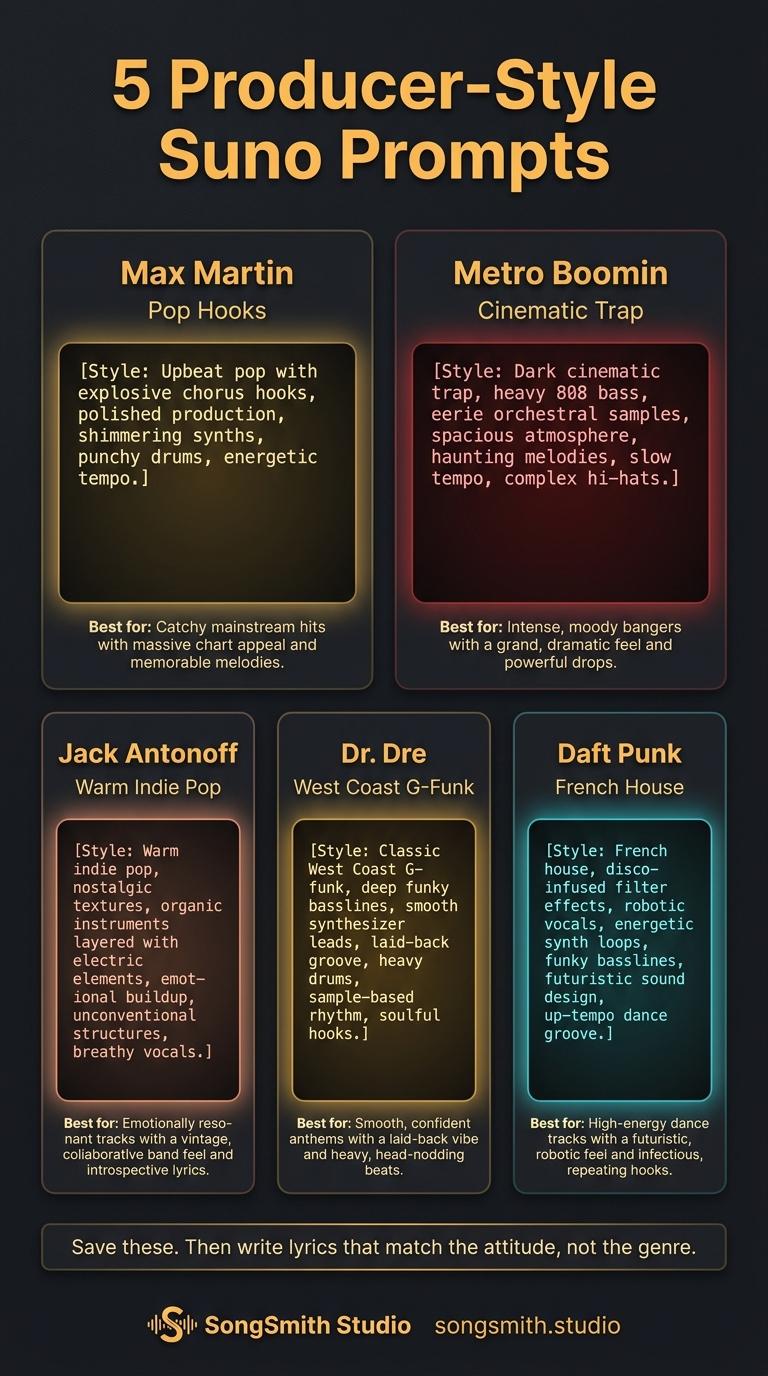
5 Producer-Style Suno Prompts (Max Martin, Metro Boomin, Antonoff, Dr. Dre, Daft Punk)
Stop describing genres: describe producers. 5 copy-paste Suno style prompts that summon Max Martin pop, Metro Boomin trap, Jack Antonoff indie, Dr. Dre G-funk, and Daft Punk house.
4 min read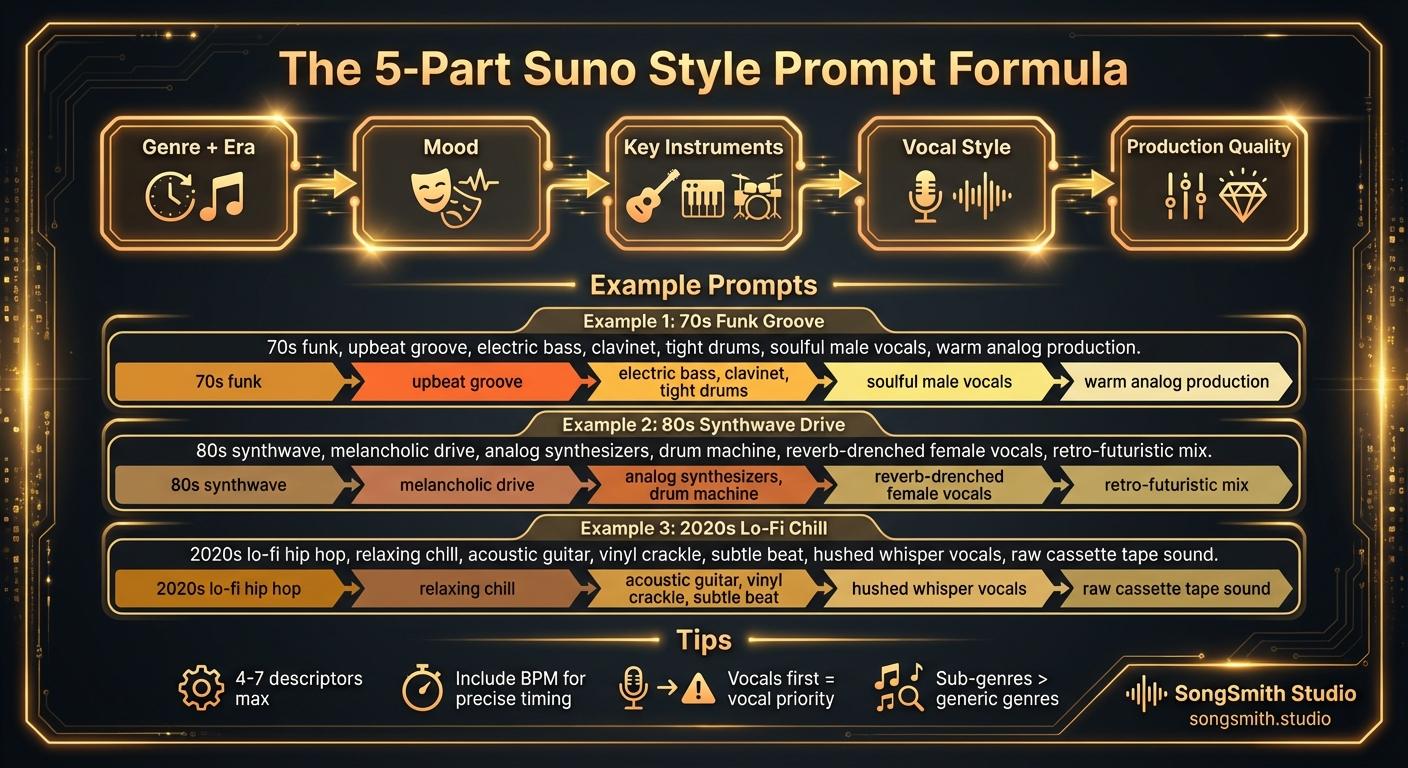
Craft Precise Style Prompts Using This Battle-Tested Formula
Master the 5-part formula for Suno style prompts: Genre + Era, Mood, Instruments, Vocal Style, Production. Learn tips for better results and example prompts that work.
2 min read