Getting Suno to Do Unusual Time Signatures and Complex Rhythms
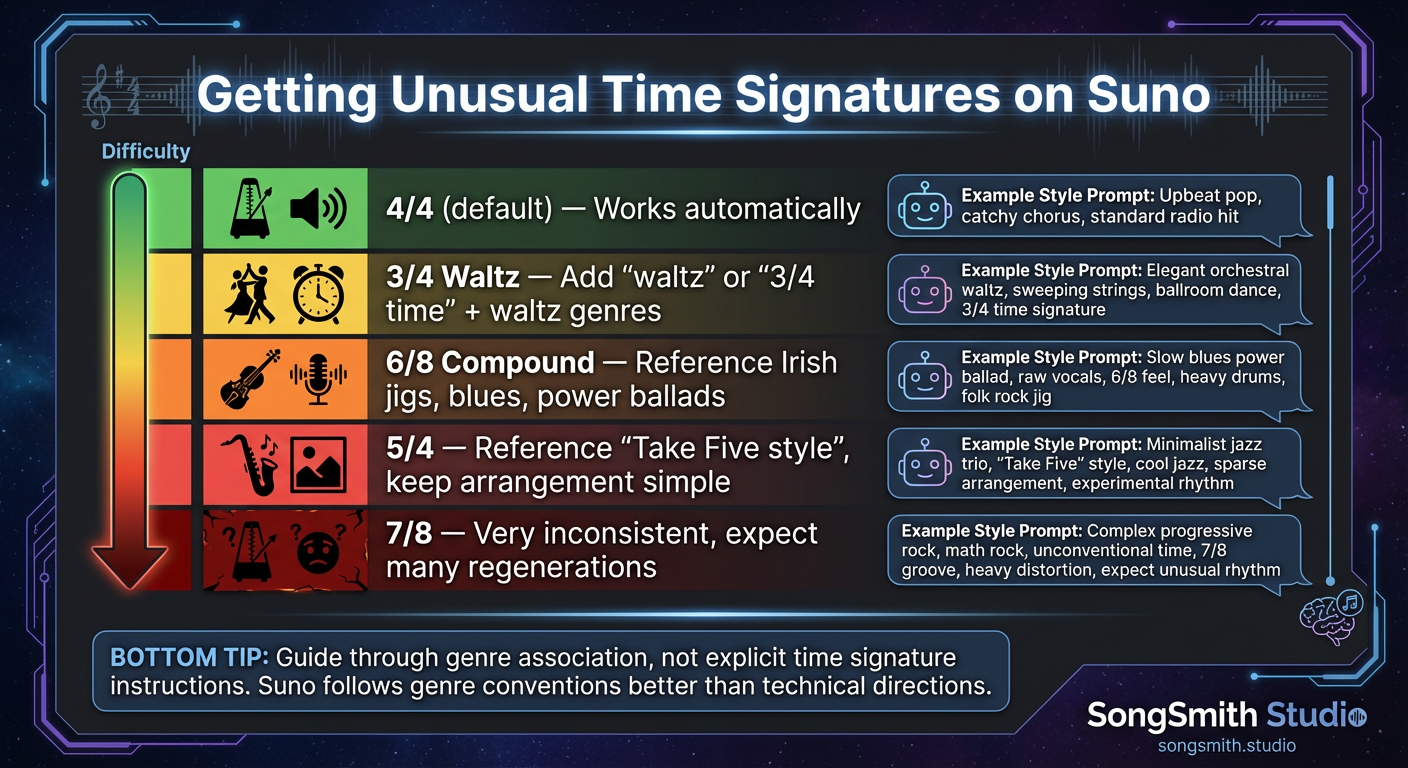
If you've tried getting Suno to generate in anything other than 4/4, you know it's a struggle. Suno defaults to standard 4/4 time for almost everything. But unusual time signatures are absolutely possible. They just require specific tricks and a realistic understanding of what Suno can do reliably.
The Reality: Suno Prefers Default Patterns
Suno's neural network is trained primarily on songs in 4/4 time, which is why it defaults there. Getting 3/4, 6/8, 5/4, or 7/8 is possible but requires you to guide it through genre associations rather than technical instructions. Suno follows genre conventions better than it follows explicit time signature commands.
3/4 Time (Waltz): Surprisingly Reliable
The good news: 3/4 time is one of the most reliable odd meters on Suno because so many genres naturally use it.
- Include 'waltz' or '3/4 time' explicitly in your style prompt.
- Reference genres that naturally use 3/4: waltz, folk ballads, some classical pieces.
- Write your lyrics in 3-syllable rhythmic patterns to help guide Suno toward the right feel.
Example style prompt:
Elegant waltz, 3/4 time, piano and strings, orchestral, sweeping, classicalPro tip: Pair 3/4 with classical or folk genres. Suno associates these genres with waltz time and responds much more reliably.
6/8 Time (Compound Time): Moderately Reliable
6/8 is compound time that works well for jigs, blues, and certain power ballads. Suno can handle it when you guide it properly.
- Reference specific genres that use 6/8: Irish jigs, blues, some rock power ballads.
- Include '6/8 feel' or '6/8 time' in your prompt.
- Use acoustic or traditional instruments to reinforce the 6/8 vibe.
Example style prompt:
Irish folk jig, 6/8 time, fiddle and bodhrán, lively, acoustic, traditional5/4 Time: Inconsistent Results
5/4 is where things get tricky. Suno struggles here, but you can improve your odds with the right approach.
- Reference specific songs known for 5/4. 'Take Five' is the classic. Use 'Take Five style' as your guide.
- Keep your arrangement simple. Fewer instruments = better chance of maintaining the time signature.
- Write your lyrics with 5-syllable phrases to match the time feel.
- Be prepared to regenerate many times. Success rate is maybe 30–40% with 5/4.
Example style prompt:
Modern jazz, Take Five style, 5/4 time, cool, piano-driven, sophisticated7/8 Time: Very Inconsistent
7/8 is Suno's most difficult odd meter. It rarely comes out clean, but here's what sometimes works:
- Reference genres or songs that famously use 7/8 (progressive rock, metal).
- Simplify your arrangement dramatically.
- Expect many regenerations before you get something usable.
- Consider the workaround: generate sections separately with different tempos, then stitch them together in a DAW.
7/8 consistency rate is low enough that you might want to explore alternatives like progressive rock in 4/4 with syncopated rhythms instead.
Tempo Changes and Rubato: The Workaround
Suno cannot directly control tempo changes or rubato within a single generation. If you need a song with a tempo shift or accelerando, here's what to do:
- Generate the intro section at one tempo.
- Generate the chorus at a different tempo.
- Download both as audio files.
- Stitch them together in Audacity, GarageBand, or your favorite DAW with crossfades.
The Master Strategy: Guide Through Genre, Not Technique
This is the key insight: don't fight Suno by telling it the time signature. Guide it through genre association. Suno's training means it understands that waltzes are in 3/4 and jigs are in 6/8. Use that knowledge. Pick a genre that naturally lives in your target time signature, and let Suno follow the genre convention.
Unusual time signatures are possible on Suno, but they require patience and the right approach. Master 3/4 and 6/8 first, experiment cautiously with 5/4, and approach 7/8 with realistic expectations, or use it as a creative excuse to bounce between sections in your DAW.
Create your first Suno album on SongSmith
From a single idea to a complete, YouTube-ready album. AI lyrics, Suno automation, album art, and video rendering — all in one workflow.
Get started freeKeep reading
![Three-column cheat sheet showing all Suno structure tags: Structure column with [Intro], [Verse], [Chorus], [Bridge], [Outro], [Break], [Interlude]. Vocal Delivery column with [Whispered], [Spoken Word], [Belted], [Falsetto], [Harmonized], [Ad-lib]. Instrumental column with [Instrumental], [Guitar Solo], [Piano Solo], [Drop]. Bottom shows a perfect song template flowchart.](/_next/image?url=%2Fblog%2F03-suno-structure-tags-cheat-sheet.jpeg&w=3840&q=75)
Master Every Suno Structure Tag for Professional Song Organization
Complete reference of Suno structure tags: [Verse], [Chorus], [Bridge], [Intro], [Outro], vocal delivery tags, and instrumental tags. Save this cheat sheet for every session.
3 min read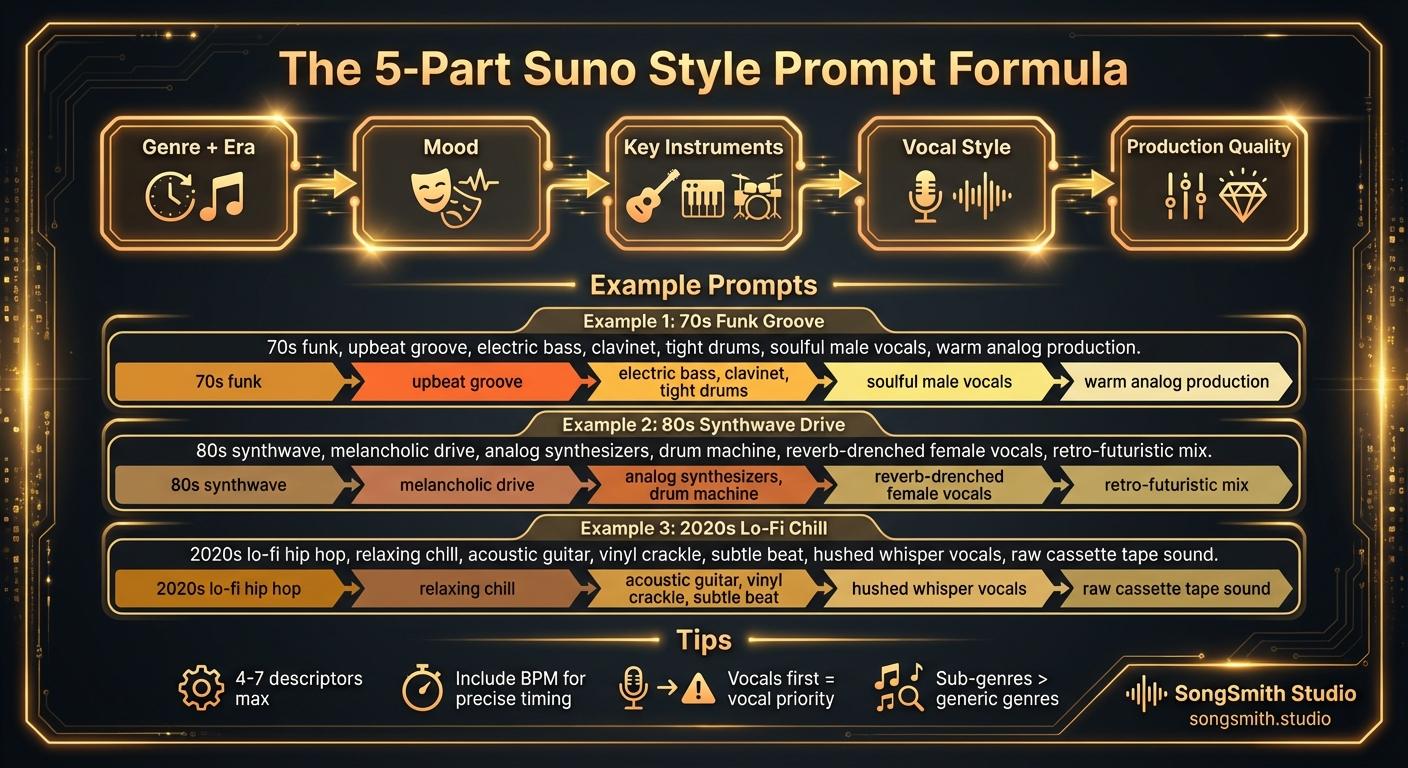
Craft Precise Style Prompts Using This Battle-Tested Formula
Master the 5-part formula for Suno style prompts: Genre + Era, Mood, Instruments, Vocal Style, Production. Learn tips for better results and example prompts that work.
2 min read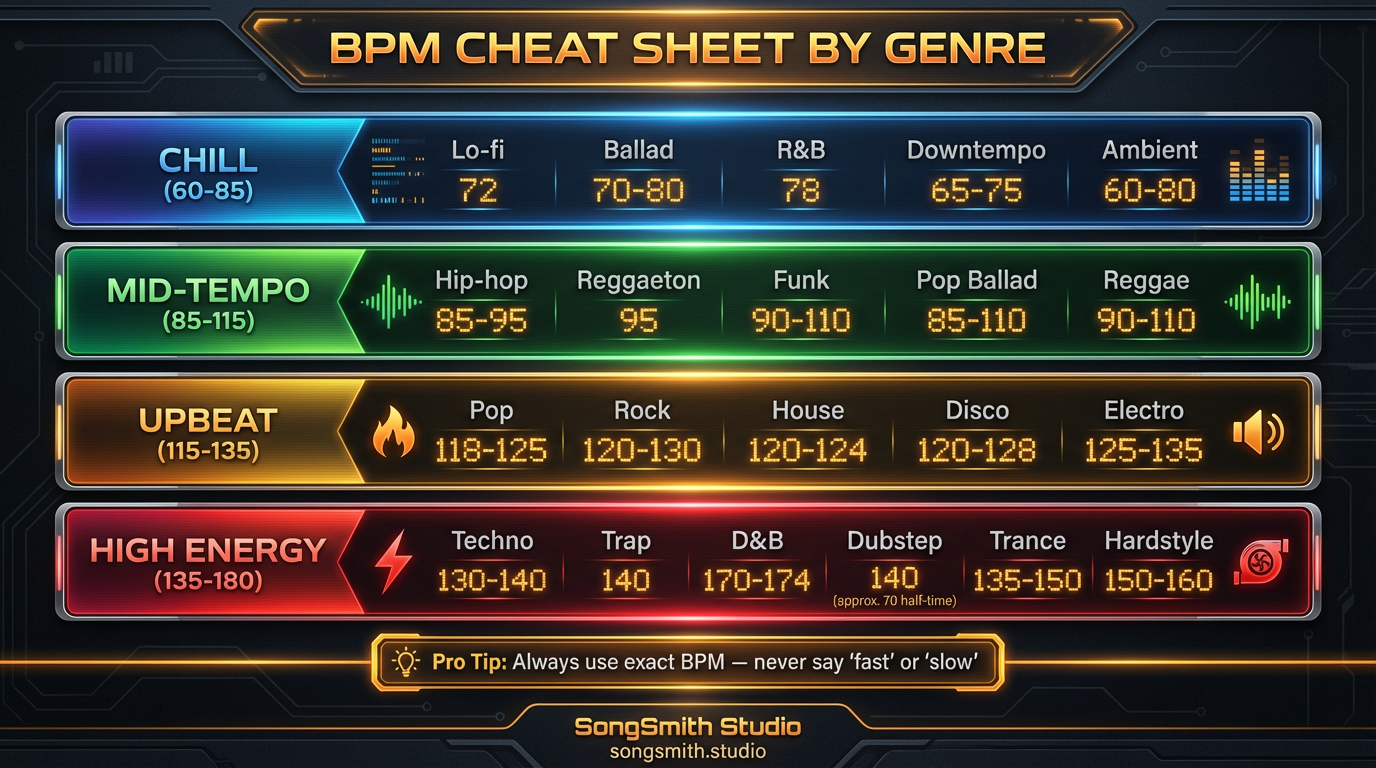
BPM Cheat Sheet by Genre: Stop Saying Fast or Slow
Never guess BPM again. Reference exact tempo ranges for every genre from lo-fi to hardcore punk. Control your Suno song's energy with precise beats per minute.
3 min read