Album Cohesion Cheat Sheet: Make 10 Songs Feel Like One Album on Suno
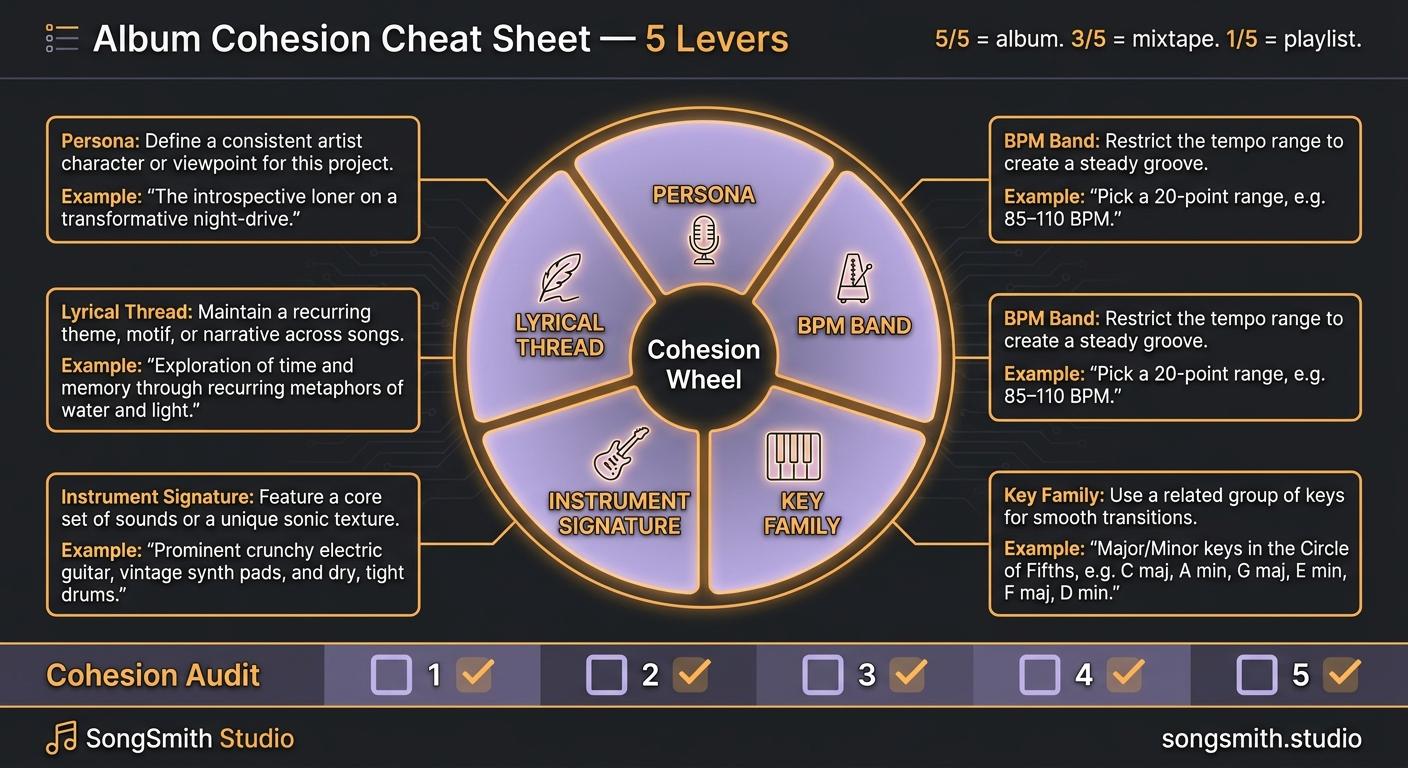
A song is a moment. An album is a *world*. The thing that makes 10 separate Suno generations feel like one body of work isn't *theme*. It's the sonic DNA they share. After helping creators ship full albums through SongSmith, the same 5 cohesion levers come up every time. Get even 3 of these right and a tracklist starts to feel like an album instead of a playlist.
Why Most Suno Albums Sound Like Playlists
Each Suno generation is independent. There's nothing technically tying track 3 to track 4. The model has no memory of what your last song sounded like. Without explicit cohesion choices on your end, you end up with 10 individually good songs that don't *belong* together. The fix is choosing a small set of constraints upfront and applying them across every track.
Lever 1: Lock the Vocalist with a Persona
This is the single biggest one. If you're on Suno Pro, generate a Persona from your favorite track and use it on every song. The voice character (timbre, accent, vibrato style) stays identical across the album. No persona? Use the *exact same* vocal description verbatim on every song:
breathy male tenor with slight rasp, intimate close-micCopy-pasted, never improvised. Even tiny variations across tracks make the album feel like different artists.
Lever 2: Pick a BPM Band, Not a BPM
Albums fall apart when track 3 is 75 BPM and track 4 is 140. Pick a band of 20–25 BPM and stay inside it. The contrast inside the band creates pacing; the unity of the band creates cohesion.
- Cozy lo-fi album: 70–90 BPM
- Indie folk album: 85–110 BPM
- Pop album: 105–125 BPM
- Trap album: 130–160 BPM (with half-time variance for ballads)
Lever 3: Stay in a Key Family
Pick 2–3 related keys and rotate. Related = relative major/minor + the dominant. Example for a sad indie album:
- A minor (the home base, most songs)
- C major (the relative, for the hopeful tracks)
- E minor (the dominant, for the climactic / dark tracks)
Suno respects key tags when placed in the section header: [Verse: A minor, fingerpicked]. The listener won't *consciously* know you stayed in a key family. They'll just feel the album "flow."
Lever 4: Recurring Instrument Signature
Pick one instrument that shows up on *every* track, even if buried. A Mellotron pad. A specific guitar tone. Brushed snares. A vinyl crackle production tag. This is the sonic thread the ear unconsciously tracks. Many famous albums do this. Bon Iver's *For Emma* has the same fingerpicked guitar on every track; Frank Ocean's *Blonde* has the same vocal pitching effects.
Lever 5: Lyrical Theme Thread
Pick 3–5 recurring images and weave them through different songs. A color, a place, a season, a name. Don't be heavy-handed, just plant them. Listeners notice on replay 2–3, which is when albums become *theirs*.
The Cohesion Audit
Run this 5-question audit on every album you build:
- Same vocal Persona / verbatim vocal description across all tracks?
- All BPMs inside a 20-point band?
- All keys in the same 2–3 key family?
- One instrument or production tag on every track?
- 3–5 recurring lyrical images woven through?
5/5 = album. 3/5 = mixtape. 1/5 = playlist.
How to Use the Cohesion Levers
Here's a complete 6-track album skeleton using all 5 levers. Same persona, same BPM band (88–104), same key family (D minor / F major / A minor), recurring "rain" image.
Album Setup
Persona: "warm female alto, slight raspy tone, intimate close-mic" (locked across all tracks)
BPM band: 88–104
Key family: D minor (home), F major (relative), A minor (dominant)
Tracklist
Track 1 - "Open Window"           | F major | 96 BPM  | [Verse: rain on glass]
Track 2 - "Half a Photograph"     | D minor | 88 BPM  | [Verse: rain on the empty side]
Track 3 - "Almost Mine"           | F major | 102 BPM | [Bridge: the rain stopped early]
Track 4 - "Forty Days"            | D minor | 90 BPM  | [Verse: forty days of rain]
Track 5 - "Drought"               | A minor | 100 BPM | [Chorus: where did the rain go]
Track 6 - "Open Window (Reprise)" | F major | 94 BPM  | [Outro: rain returns, fades out]
Same vocalist, narrow BPM band, three related keys, "rain" threaded through every track. You've just built an album, not a playlist.
Cohesion Is a Choice, Not an Accident
Most Suno creators build albums one song at a time and *hope* they'll feel cohesive in the end. They never do. Albums that work are constructed top-down: pick the constraints first, then make every song fit them. If you build albums regularly, the SongSmith album planner enforces these levers automatically, picks a BPM band, locks the persona, and threads the key family across the tracklist before you generate. But even a hand-built spreadsheet works. The levers are what matter, not the tool.
Automate your Suno workflow
SongSmith handles the entire pipeline — AI lyrics, Suno generation, album art, and 1080p video — so you can focus on the music.
Get started freeKeep reading
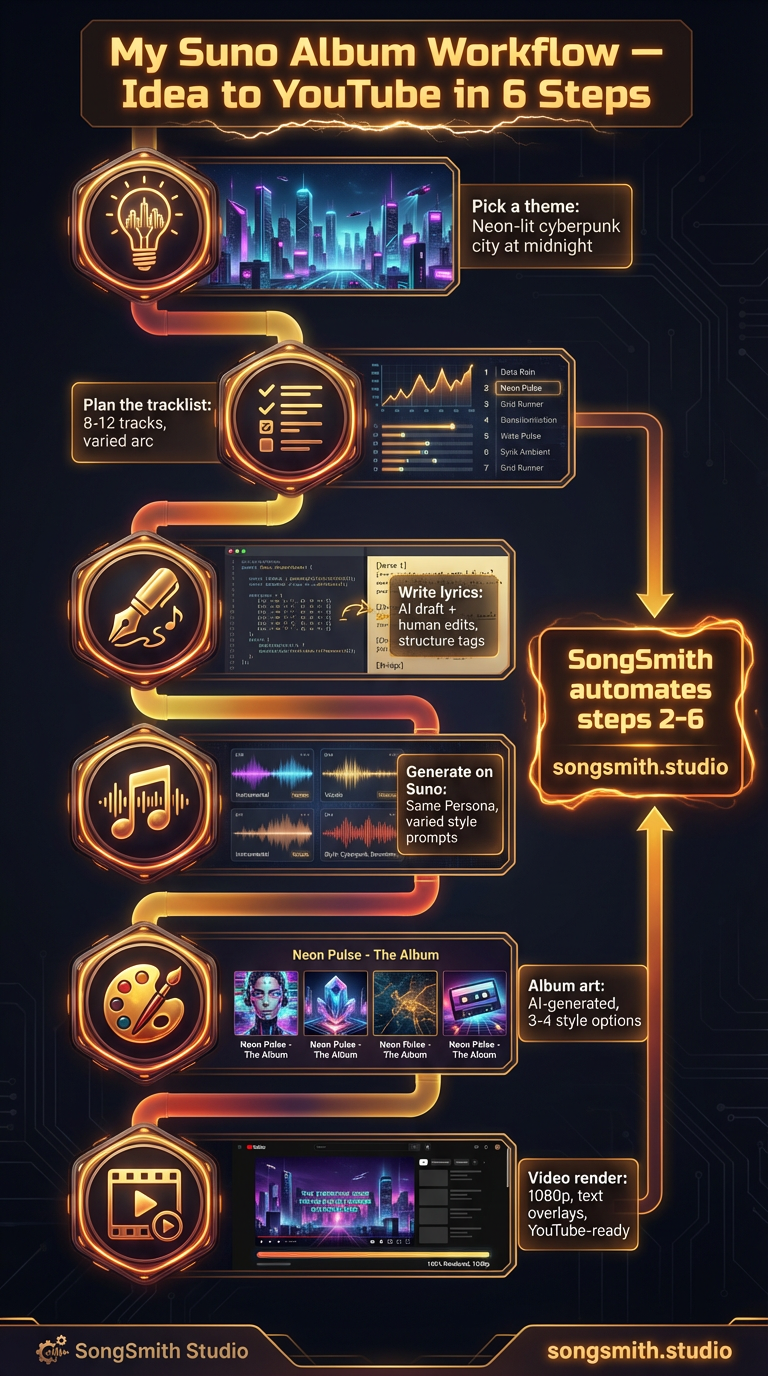
How to Create Full Albums on Suno and Publish Them to YouTube
Learn the complete album workflow for creating and publishing AI music on YouTube. Plan, generate, render, and upload albums efficiently with Suno in under an hour.
3 min read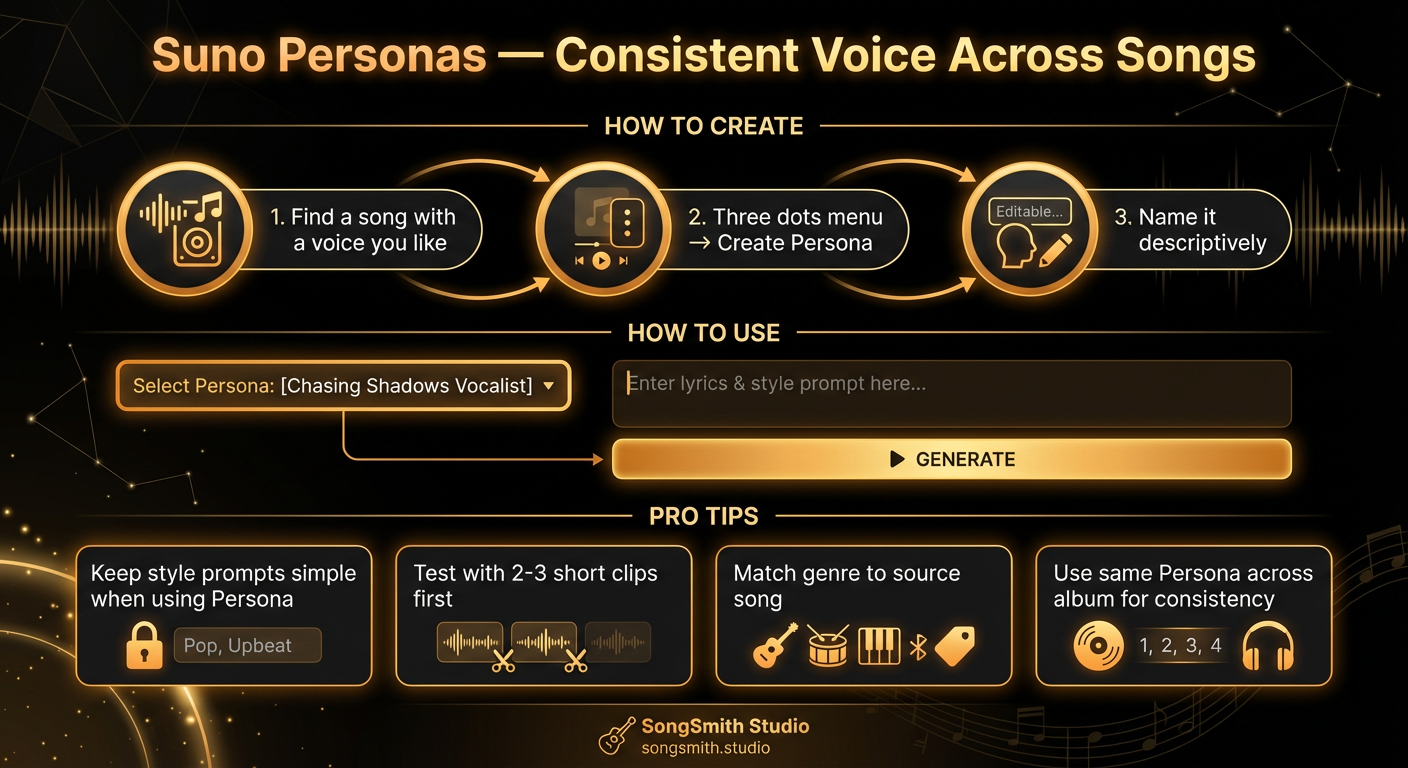
Use Suno Personas to Lock In a Consistent Vocal Identity
Master Suno Personas to get the same voice across all your songs. Learn how to create, use, and combine Personas for albums with consistent vocal identity.
4 min read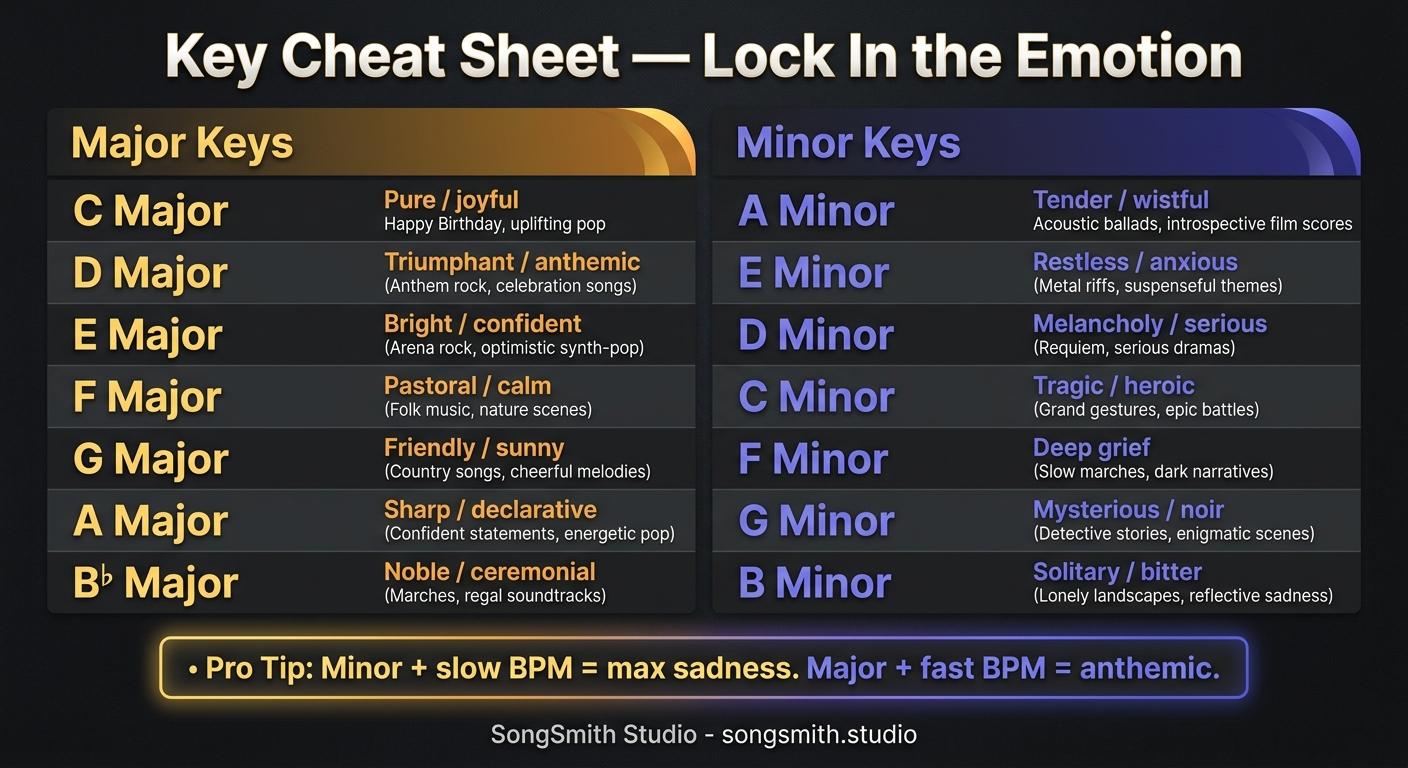
Key Cheat Sheet: Lock In the Emotion of Your Suno Song
Every major and minor key has its own emotional fingerprint. Use this reference chart to specify the exact key Suno should use, and stop defaulting to bland C major.
3 min read