Vocal Layering 101: When to Stack Vocals on Suno and When to Stop
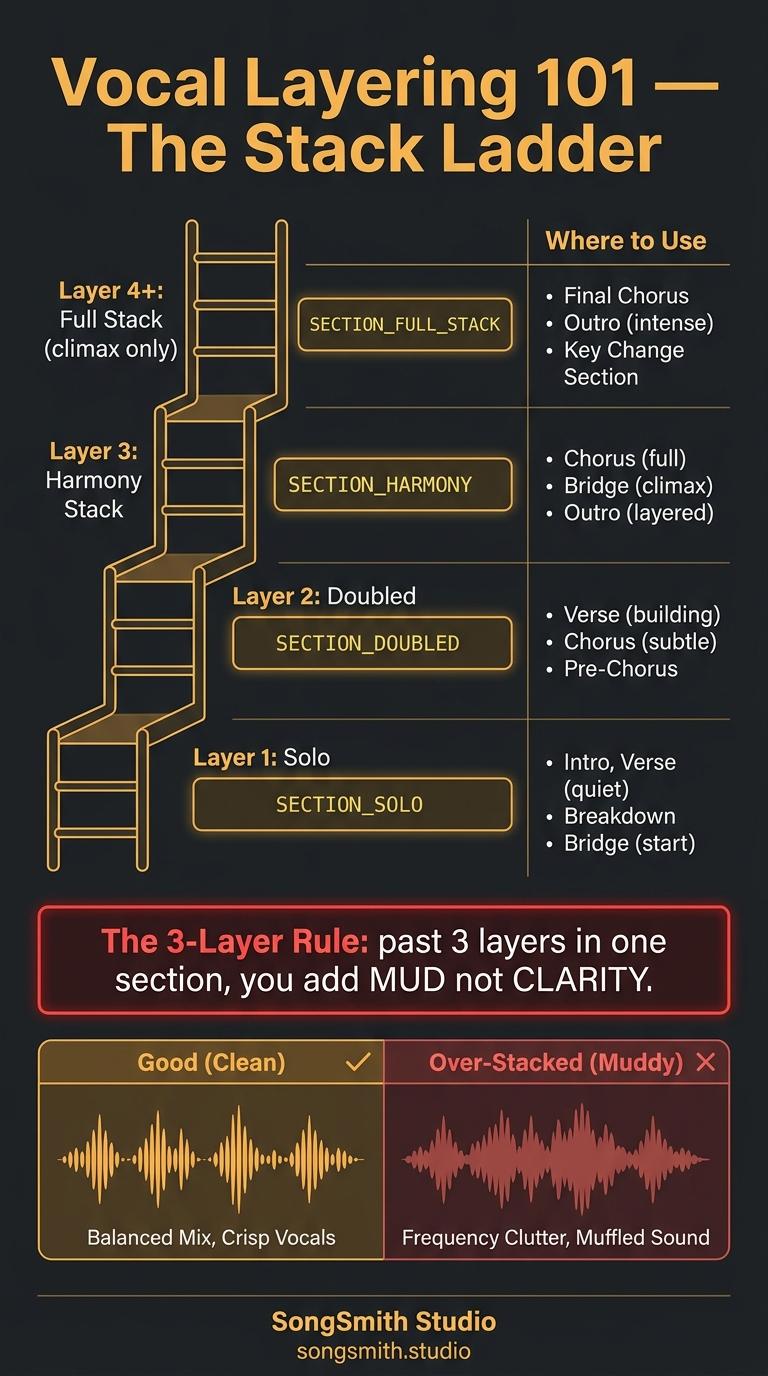
The most common over-correction in Suno: someone hears their first generation, thinks "the vocals sound thin," and starts stacking every layer tag they can find. Three songs later they're asking why everything sounds like mud. The truth is vocal stacking is a ladder, and you only climb as high as the section needs. Past 3 simultaneous layers, you stop adding *clarity* and start adding *mud*. Here's the rung-by-rung breakdown with the exact tags Suno responds to.
Why More Layers ≠ Bigger Sound
Each vocal layer occupies the same frequency range, typically 200Hz to 4kHz. Stacking 5 vocals doesn't multiply the size of that range; it just crams more signals into the same space. Past about 3 layers, the layers start *masking* each other and the listener loses the ability to track the lead melody. The trick is matching the layer count to the section, not the song.
Layer 1: Solo Vocal (Verse, Intimate Moments)
[Verse: dry close-mic vocal, single take, no doubles]- One voice. No reverb wash. No harmonies.
- Purpose: pull the listener in, force closeness.
- Use in: verses, opening lines, vulnerable bridges, intros.
Layer 2: Doubled Vocal (Pre-Chorus, Second Verses)
[Pre-Chorus: vocal doubled in unison, slight detune for width]- Same melody, sung twice, one slightly detuned (Suno does this if you say "doubled").
- Purpose: thickness without losing intimacy.
- Use in: pre-choruses, chorus build-ups, second verses where you want more weight than verse 1.
Layer 3: Octave or Third Harmony (Chorus, Hook Moments)
[Chorus: vocal stack with octave harmony above and a third below, gated reverb, soaring]- Lead + double + one harmony layer (octave up or a third below).
- Purpose: the *lift*. This is where the chorus actually opens.
- Use in: choruses, hook lines, final-chorus payoffs.
Layer 4+: Full Stack (Final Chorus, Climactic Moments Only)
[Final Chorus: full vocal stack, lead + double + octave up + third + ad-libs, stadium reverb, no held back]- Lead + double + octave + third + ad-libs.
- Purpose: catharsis.
- Use in: the final chorus, the last 8 bars before the outro. *That's it.*
The 3-Layer Rule
Past 3 simultaneous vocal layers in any single section, you stop adding clarity and start adding mud. The exception is the climactic final chorus where you *want* the wash. For every other section, stop at 3.
The Anti-Pattern: Same Stack on Every Section
If your verse and chorus have the same vocal stack, the chorus has nowhere to go. The dynamic effect comes from the *delta*, not the absolute count. A verse with 1 layer and a chorus with 3 feels twice as big as a verse with 3 and a chorus with 5, even though the second pair has more layers overall.
Pro Tips for Vocal Stacking
- Detuning ("slight detune") creates width without effects. Always cheaper than reverb.
- Ad-libs should appear in *one* section per song: usually the final chorus or last 4 bars. Sprinkled everywhere = annoying.
- Stack tags work best when you spell out the harmonic interval ("octave up", "third below"). "Vocal stack" alone is too vague for Suno to lock onto a specific interval.
- Don't stack with multiple effects at once. Pick stacking *or* heavy reverb, not both. They occupy the same frequency space and cancel out.
How to Use the Stack Ladder
Here's a side-by-side of the same chorus written *correctly* (3 layers) vs *over-stacked* (6 layers). Generate both. The second one will sound noticeably worse.
Good (3 Layers, the Lift Works)
[Chorus: lead vocal + doubled in unison + octave harmony above, gated reverb on snare only, soaring]
The whole world's awake tonight
And I'm the only thing standing still
Over-Stacked (6 Layers, Wash Eats the Melody)
[Chorus: lead + double + octave up + octave down + third above + fifth below + reverb wash + heavy ad-libs + delay throw]
The whole world's awake tonight
And I'm the only thing standing still
The first one breathes. The second one drowns. Same lyric, same melody, completely different result.
Restraint Is the Whole Skill
Vocal layering is one of the few Suno techniques where the *advanced* move is doing less, not more. Learn the ladder, match the section to the rung, and resist the urge to climb past 3 outside of the climactic moment. The songs that come out the other side will sound bigger precisely because they don't try to.
Create your first Suno album on SongSmith
From a single idea to a complete, YouTube-ready album. AI lyrics, Suno automation, album art, and video rendering — all in one workflow.
Get started freeKeep reading
![Dark-themed cheat sheet with two columns. Stacking & Layering on the left (6 tags) and Effects on the right (6 tags), totaling 12 numbered rows. Each row shows the tag name in bold and a one-line description. Stacking tags: double-tracked, octave stack, layered harmonies, gang vocals, call-and-response, ad-libs. Effect tags: autotuned, vocoder, talkbox, reverb-drenched, slapback delay, whisper layer. Each column has a colored left accent bar. Bottom banner: Dry verse + stacked chorus = dynamic contrast. Below that, a code example of a [Chorus] section with stack tags.](/_next/image?url=%2Fblog%2F34-suno-vocal-stack-cheat-sheet.png&w=3840&q=75)
The Vocal Stack Cheat Sheet: 12 Tags That Make Suno Vocals Sound Pro
Pro-sounding choruses are never one voice. Use these 12 vocal-stacking and effect tags: doubles, harmonies, ad-libs, vocoder, reverb, to lift any Suno generation.
3 min read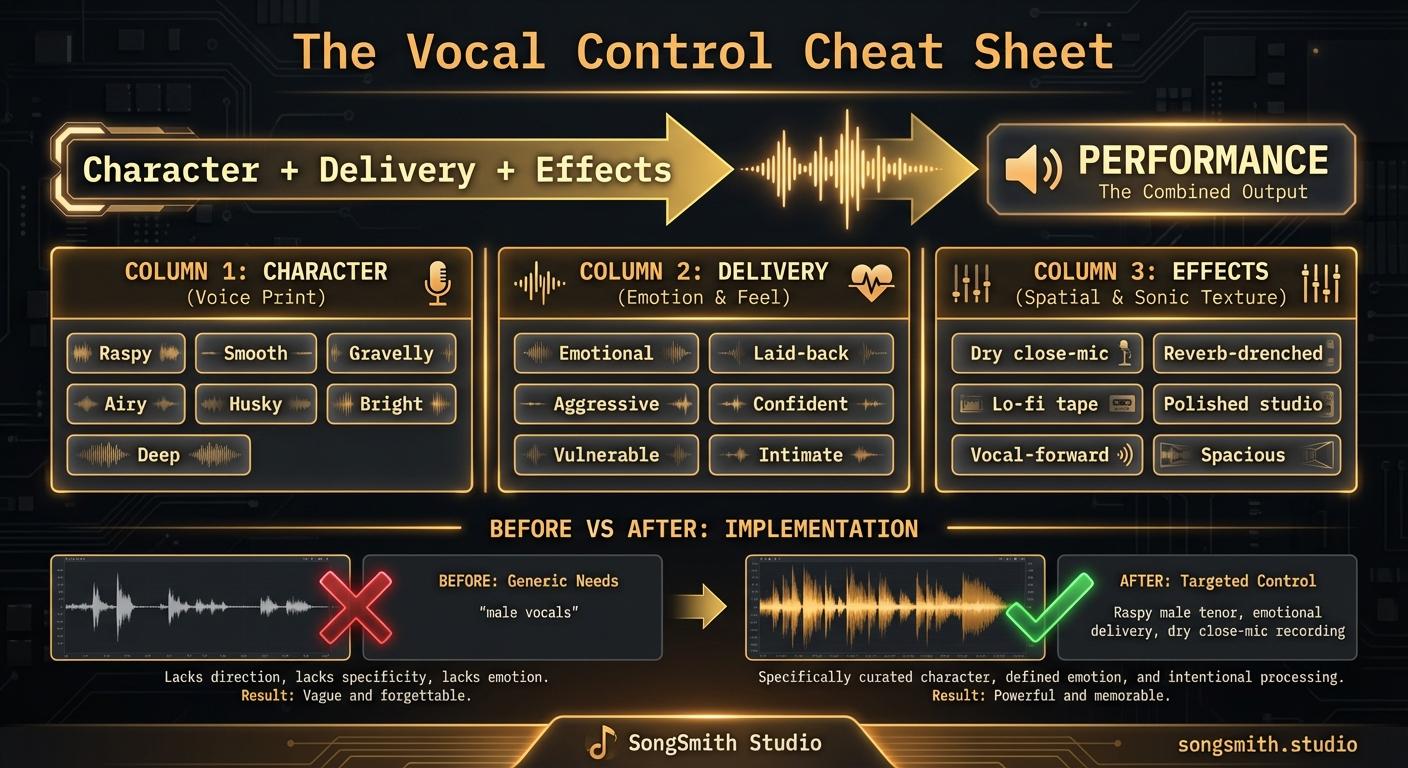
The Vocal Control Cheat Sheet: Master the 3-Layer Formula
Control Suno vocals with the Character + Delivery + Effects formula. Master male, female, and unique vocal descriptions for professional-sounding AI music.
3 min read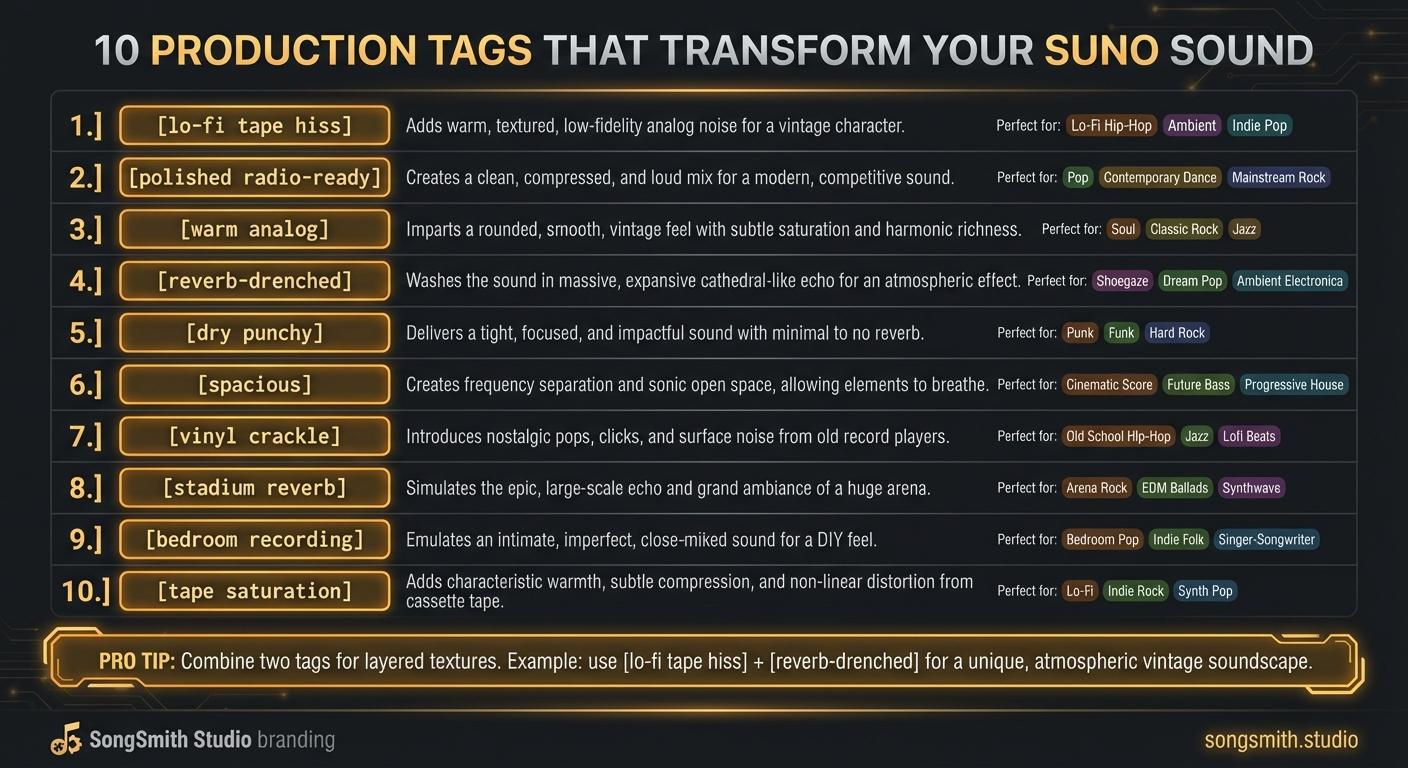
10 Production Tags That Transform Your Suno Sound
Master production tags to control texture, space, and vibe in Suno. Learn lo-fi, polished, analog, reverb, and more, transform your track's sonic character.
4 min read