The Sad Song Formula: How to Make Suno Actually Sound Heartbroken
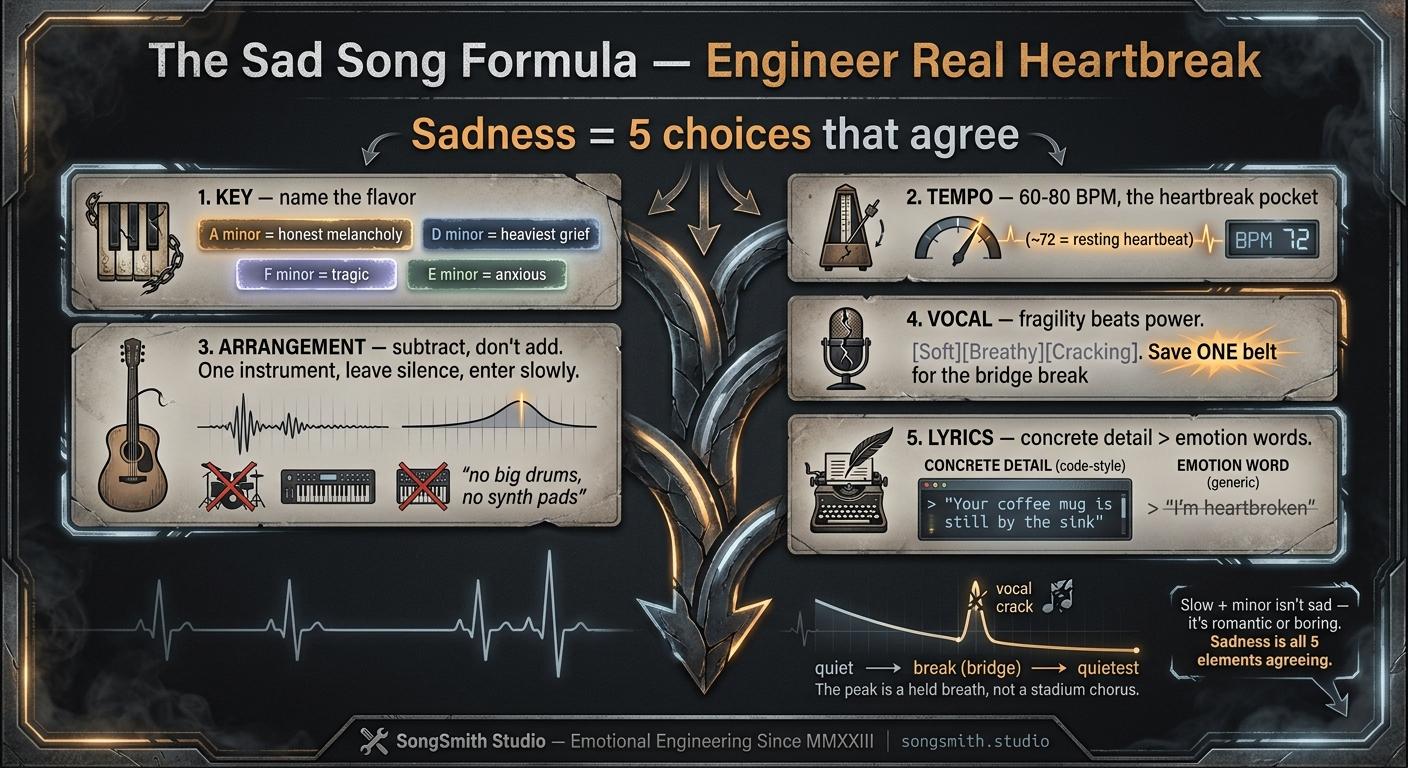
"Sad" is the most-requested mood and the most badly-prompted one. Slow + minor isn't sad. It can be romantic, cinematic, or just boring. Genuine emotional weight comes from layering five elements so they all agree. Miss one and the song stays at arm's length. Here's the full stack.
1. Key: pick the flavor of sad (post 31)
Minor keys carry the sadness, but they're not interchangeable:
- A minor → plain, honest, melancholy. The everyman sad.
- D minor → the heaviest, most serious grief (it's not a meme, it really is the darkest-feeling common key).
- F minor / C minor → tragic, dramatic, cinematic loss.
- E minor → restless, anxious sadness with a little fight left in it.
Don't leave the key blank. Suno defaults toward bright keys and quietly sabotages your sad song. Name it.
2. Tempo: slow, but not a dirge
60-80 BPM is the heartbreak pocket (post 23). Too fast and it can't ache; too slow (under ~55) and it drags into boredom instead of grief. ~72 BPM (roughly a resting heartbeat) is the sweet spot for ballads.
3. Arrangement: subtract, don't add
This is the one people get backwards. Sadness lives in space, not in lush production. Strip it down:
- Start with one instrument: piano or acoustic guitar, alone.
- Leave silence between phrases. The gaps are where the feeling sits.
- Add elements slowly: strings or a low cello entering on verse 2, brushed drums late, never all at once.
- Negative-prompt the busyness:
no big drums, no synth pads, no upbeat energy(post 29 on negative prompts).
A crowded sad song isn't sad. It's just a slow loud song.
4. Vocal: fragility beats power
A belted power vocal reads as triumphant, not broken. For sadness you want restraint and cracks:
[Soft][Breathy][Whispered][Vulnerable][Cracking voice][Trembling]- Close-mic'd, intimate, slightly imperfect: the humanization controls from post 60 are doing real work here. A too-perfect vocal kills sadness.
- Save one
[Belted]moment for a single line in the bridge: the one time the dam breaks. The contrast is devastating.
5. Lyrics: concrete detail and restraint
This is where most sad songs fail. "I'm so sad, my heart is broken, I miss you so" tells; it doesn't show. Real sadness is specific and understated:
- Concrete detail over emotion words. Not "I'm heartbroken" → "Your coffee mug is still by the sink." The object carries the grief.
- Restraint. The most devastating lines underplay it. Let the listener feel it instead of being told to.
- Avoid the clichés (post 52): "tears like rain," "broken heart," "torn apart" are so worn they numb the listener. Reach for slant rhymes (post 75) and one true image instead.
- The turn. The best sad songs have one small pivot: a memory, a "but," a direct address, usually in the bridge.
The dynamics that seal it (post 40):
Sadness is quiet → slightly less quiet → quiet again, never a stadium chorus. The peak of a sad song is a held breath, not an explosion. Build to the bridge where the vocal finally cracks (the emotional-whiplash "killer combo" from post 58, sung restraint into a broken-voiced bridge), then pull all the way back for the final verse. End sparse: one instrument, one voice, fade.
Putting it together, a worked sad ballad:
Style box:
sad indie folk, singer-songwriter, 72 BPM, in D minor,
solo fingerpicked acoustic guitar, distant cello entering late,
fragile and intimate, sparse and restrained,
close-mic'd vulnerable female vocal, raw and slightly imperfect,
no big drums, no synth pads, no upbeat energy

Lyrics:
[Verse 1]
[Soft] [Breathy] [Close-mic]
Your coffee mug is still beside the sink
I haven't moved it, I don't know what I think

[Chorus]
[Vulnerable] [Restrained]
And the house just keeps on breathing
Like it doesn't know you're gone

[Verse 2]
[Cello enters] [Still soft]
I learned to sleep across the empty side
Got good at things I never thought I'd try

[Bridge]
[Cracking voice] [Belted, the one break]
SO TELL ME HOW THE MORNINGS GET EASIER
'CAUSE MINE JUST KEEP ON COMING

[Final Verse]
[Whispered] [Guitar only] [Fade]
Your coffee mug is still beside the sink
Notice everything points the same way: D minor, 72 BPM, one instrument that grows slowly, a vocal that stays fragile until one break, lyrics built on a single concrete object, and a structure that ends where it started, quieter.
Pro tips:
- One concrete object can carry a whole song. Pick a specific thing (the mug, the voicemail, the porch light) and return to it. Specificity is what makes a stranger cry.
- Underplay the vocal. If you only remember one thing: fragile beats powerful for sadness. Save the belt for one line.
- Subtract until it hurts. When a sad song isn't landing, the fix is almost always removing an instrument, not adding one.
- End sparse. Don't resolve a sad song into a big finish: fade on one voice and one instrument.
- Run the 60-second diagnosis (post 35) on the result: if it sounds "pretty" but not sad, check which of the five elements drifted bright, usually it's the key or the vocal got too polished.
Save this for the next time you need to break someone's heart in 3 minutes. What's the saddest song you've made on Suno, what made it land? Drop it below.
AI-generated lyrics with structure built in
SongSmith generates complete lyrics with [Verse], [Chorus], and [Bridge] tags already in place — ready for Suno Custom Mode.
Get started freeKeep reading
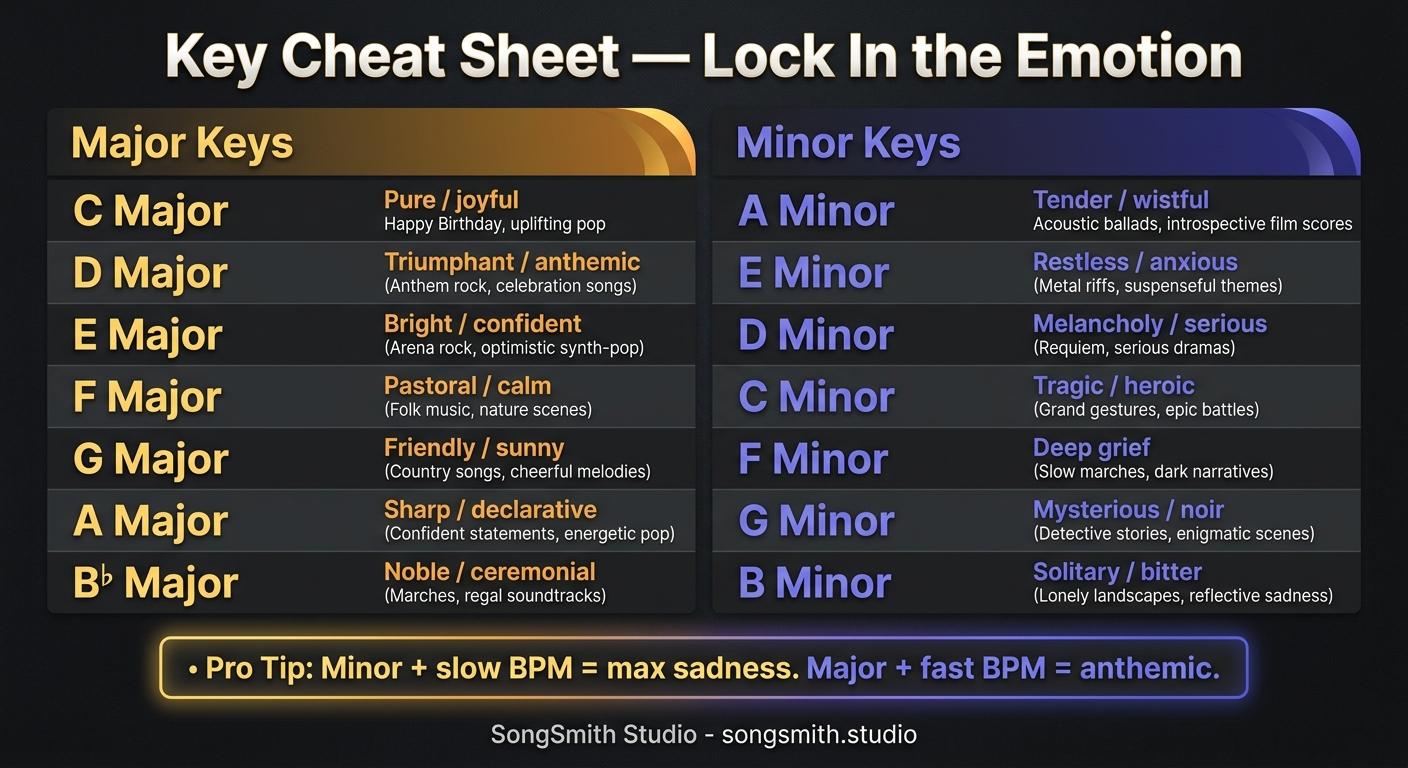
Key Cheat Sheet: Lock In the Emotion of Your Suno Song
Every major and minor key has its own emotional fingerprint. Use this reference chart to specify the exact key Suno should use, and stop defaulting to bland C major.
3 min read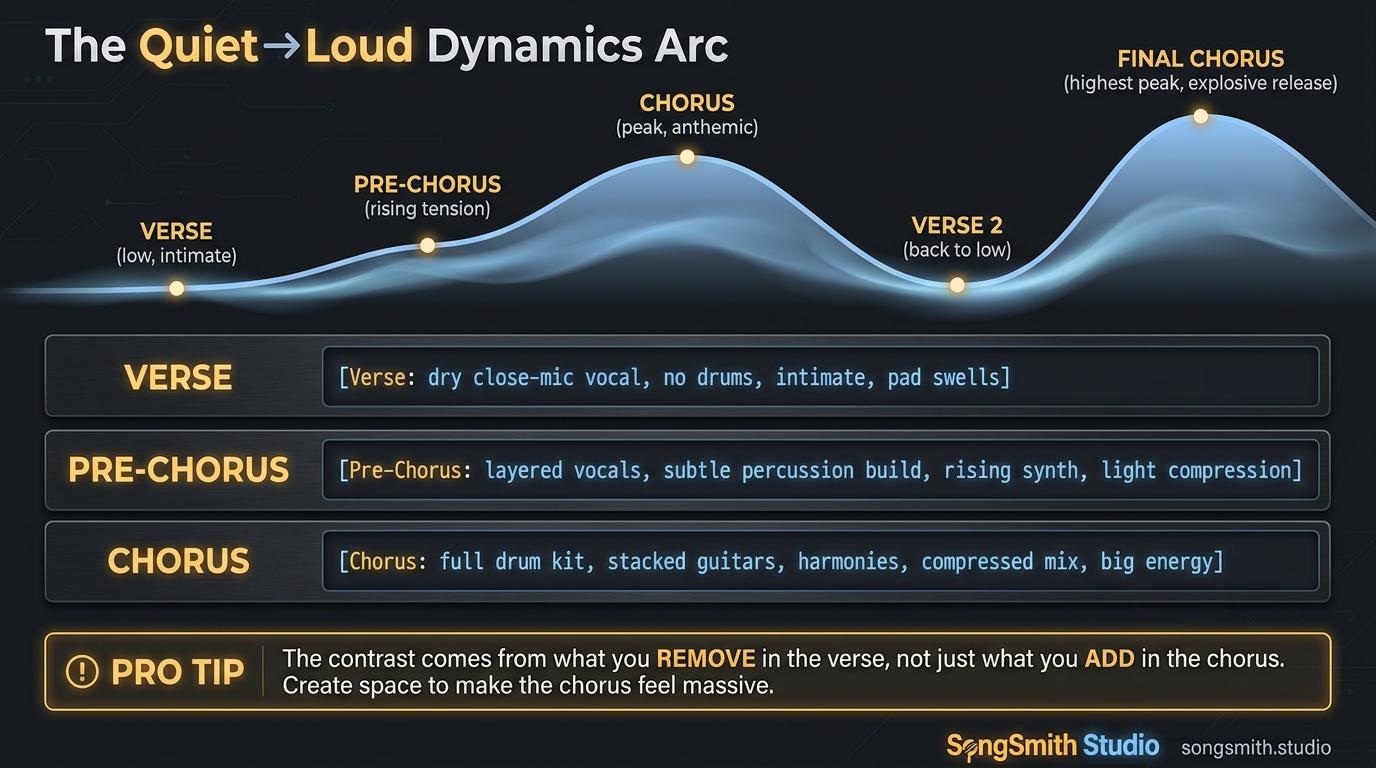
The Quiet→Loud Trick: How to Build Real Dynamics in a Suno Song
Suno defaults to loud-the-whole-time. Stage your dynamics per section with the verse/pre/chorus tag pattern, full copy-paste lyric block included.
4 min read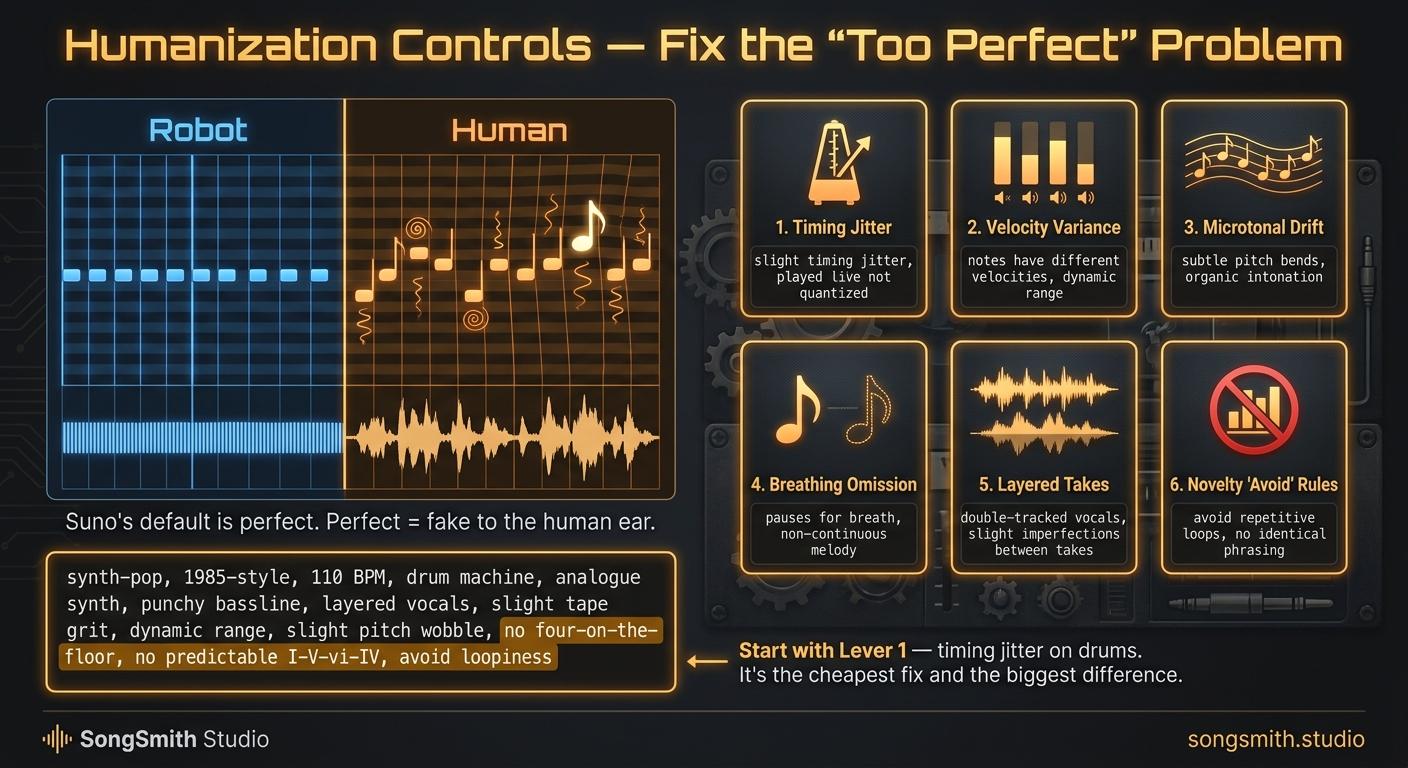
Humanization Controls: Why Your Suno Songs Sound Too Perfect (and 6 Fixes That Make Them Feel Human)
AI music fails because it's too clean. 6 humanization levers (timing jitter, velocity variance, microtonal drift, breathing omission, layered takes, novelty avoid rules) that fix it.
3 min read